
This guest post is written by Shawn Laib.
When brainstorming the best Nintendo-exclusive franchises, the usual suspects usually get named first. “Mario,” “Zelda,” “Smash Bros.,” and “Kirby” games are some of my all-time favorites. But sometimes games don’t have to challenge so many senses and nerves — they can let us decompress after a stressful day too.
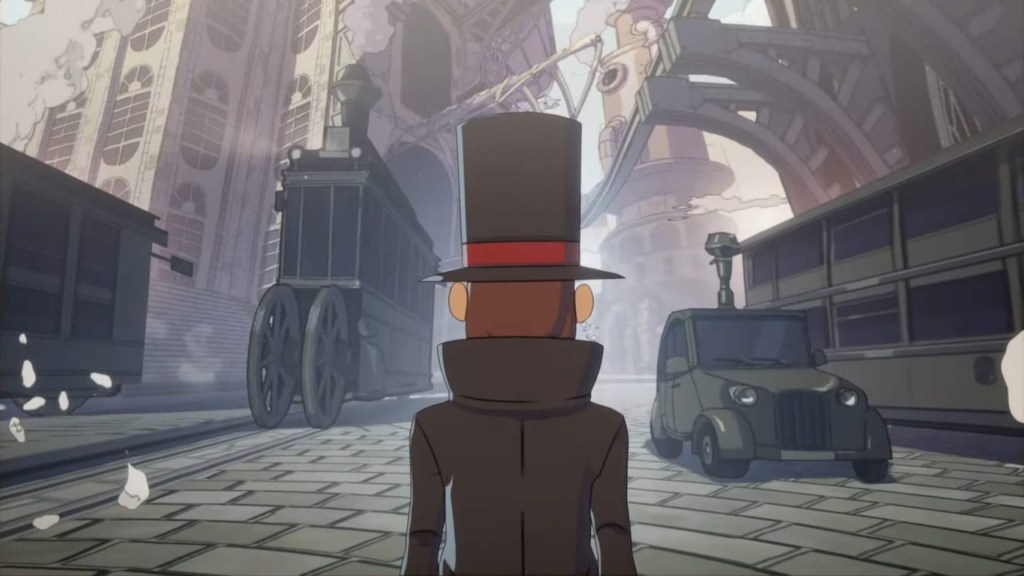
Enter the “Professor Layton” franchise. Once one of the most reliable games on Nintendo’s portable hard during the late 2000s and early 2010s, the puzzle-adventure games have been mostly dormant for quite some time now. However, “Professor Layton and the New World of Steam,” was expected last year, but ended up delayed into 2026.
This unfortunate wait means that diehard fans of these relaxing, inquisitive journeys have to wait even longer to scratch the itch that really exceedingly few other game attempts to do.
“Professor Layton” became popular at the perfect time. Released at the peak of handheld gaming and amidst the jump in popularity of mobile titles at large, these games provided a comfortable alternative for people who wanted to feel the video game equivalent of reading a novel while sipping on a hot chocolate.
Playing “Professor Layton” games require no hand-eye coordination. Because of the lack of intensity in the gameplay, just about everyone could have fun with them. It makes the series one of the truly universal experiences on any console and shows that gaming as a medium is one of the most diverse in comparison to TV and film.
Players control the titular professor and his trusty assistant, Luke, as they traverse various English locales and meet many exotic characters who aren’t exactly as they seem. There’s always a big mystery at the center of the game that unfolds like an old-school serial with twists and turns at every corner. There are no enemies to fight, no platforms to triple-jump over, and no final bosses that won’t succumb to the proper amount of brainpower.
The puzzles are the meat of these games. The interactivity of the DS touch screen allows the franchise to present block puzzles, riddles, logic problems, math equations, art diagrams, and so many more questions for the player.
“Professor Layton” was the most ingenious and enduring trailblazer of an era in which Nintendo tried to attract all sorts of non-gamers to their systems. The DS and Wii eras used gimmicks and simple experiences to garner a large number of casual fans — in no small part thanks to developers like Level-5.
Of course, not all of these ideas worked. Wii Sports? A big winner. Wii Music? Not so much.
“Professor Layton” respects its audience, and presents the type of fun that people used to have before video games, but upgrades it for a modern audience. It understands how to tell a story, how to involve the player without them feeling left out, and the mashup of genres demonstrates the power of relaxation video gaming.
When these games came out, I was in middle school and high school — some of the most trying times in a young person’s life. I didn’t have a whole lot of friends, and felt like an outcast more often than not amongst my peers. You know who wasn’t judging me, though? Professor Layton and Luke.
The characters and stories in these games felt like a safe space that I couldn’t find in real life. The music was calm, and the artwork reminded me of a less chaotic time. Enemies can be defeated with the tap of a stylus on a touch screen after completing a puzzle instead of having to battle through Bowser or Ganondorf (not that those guys are all that difficult, but you get my point).
The “Professor Layton” games aren’t going to be for everyone. Some people really need a video game to get their blood pressure pumping to feel something. These folks want the adrenaline boost that gaming can give, the harmless anxiety produced by games, so that you don’t need to take out your frustrations or tension in less productive ways.
I enjoy those games, too, obviously. But in a world with so many high-octane titles to choose from, there simply aren’t enough games like “Professor Layton.” If more people would try these games and encourage their friends to, then the hobby we cherish would become something that can be loved by third-graders all the way to retirees in nursing homes.
When “Professor Layton and the New World of Steam” comes out, it will return some much-needed comatose gaming to over-stimulated folks who have bashed a few too many boulders in “Donkey Kong Bananza” or died over and over again fighting a boss in “Metroid Prime 4: Beyond.” Never forget to allow video games to bring you solitude in the quietest moments of your life. “Professor Layton” is the pioneer of this sentiment, and I’ll forever be indebted to it.
Image Credit: “Professor Layton and the New World of Steam”


 Video Game Town