
I can’t fathom trying to explain what “Katamari” is to a normal person. Anyone with no idea of what this game entails, no context to its whimsy, or any pre-built passion for art made by Japanese developers who are clearly on the most psychedelic drugs. It would be akin to having an alien tell you about its recent vacation to another galaxy; there are just no words in our language to describe the experience.
I’ve played every non-mobile “Katamari” game since 2004. I was instantly hooked when I saw the front cover of the first game (with the cows) when reading either EGM or GameNow — I can’t remember which magazine had a story about it. And thanks to its discounted price at launch, my dad took me to EB Games and man was he not ready for what I would play later that afternoon.
This beginning cutscene that plays when you boot the game up on your PS2 really speaks volumes to the kind of adventure we all take when playing a “Katamari:”
It’s the most different game I had played up to that point. Maybe still is, today. Esoteric and idiosyncratic are just two words, with very apt meanings, but they don’t come close to the magic this game put on-screen for me. Rainbows, joy, love, ideas, mysticism, nature, healing, and wait is that weed in the thumbnail with those pandas?
Okay yeah whoever at Bandai Namco was a part of this series was definitely hallucinating under the influence of some mad shit.
The first two “Katamari” games are by far the best, with the best soundtracks, and the sparse follow-ups on bespoke consoles that came later would suffice, but aren’t as tantalizing or unique as the originals (“Me & My Katamari” for the PSP, “Beautiful Katamari” for the Xbox 360, “Katamari Forever” for the PS3, and “Touch My Katamari” for the Vita).
But now, we have the first true game since 2011. I waited all of those years, and only got remasters, but finally there is new junk to roll up and collect. New songs to sing. New levels to go through, and it is bliss. Pure heaven. There is no greater feeling than letting go of your brain and just diving into the madness and the grandeur, the color palette, and the dizzying mood swings of “Once Upon a Katamari.”
Now, on the surface, there is nothing really new here. It’s the same art style, now in HD, but the same controls, and the same basic premise — very similar in most regards. And that’s not a bad thing because an ounce of “Katamari” is still more interesting than all of the “Call of Duty” games put together. This time, there are a few interesting wrinkles thrown in to spice things up.
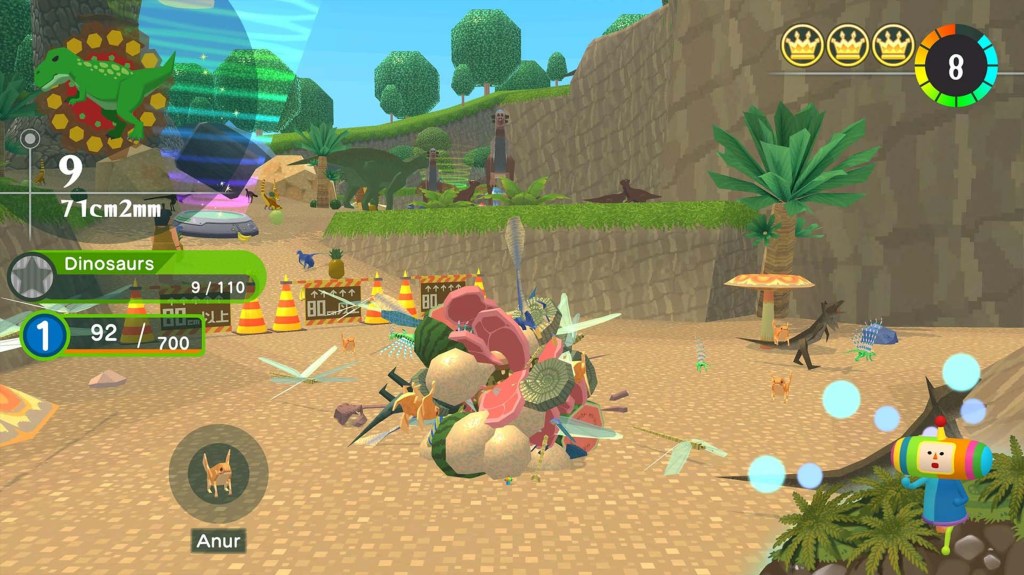
The first is power-ups you grab in the levels, like a jetpack or a slow-down stopwatch. And the second is the theming: Time travel. The King of All Cosmos (who will never shut up) sends you across famous times and eras to patch things up. Greek empire, Jurassic period, old-timey Western frontier, caveman days, etc.
And these lend themselves to new characters and items to roll into your katamari ball. Ancient Egypt has mummies! The old west has cowboys! Ancient Greece has philosophers! The Jurassic period has dinosaurs! These models would have never been made for the older games because those were strictly about the detritus found in a Japanese home, in the street, a neighborhood, or outside. With this game, it’s more wild stuff you’re finding, which is a nice new paint job over a very tried and tested formula. Roll the ball and get bigger as fast as you can.
There’s better sign posting for level requirements and exits, height restrictions and exits, and the camera will pull you over to key items. And there’s a lot of new levels, objectives, goals, and songs to digest; it’s a lot of game. Especially if you got the deluxe version or pay for the DLC, because that comes with the old soundtracks you can play during missions. You can’t skip through them at will mid-mission, but it randomly will play classics like “Lonely Rolling Star” or “Que Sera Sera.”
Series creator Keita Takahashi, from what I read online, made “cheerfully bizarre” and eccentric sculptures as an art student. His visual design then gave way to what can only be described as a children’s cartoon show come to life but stuck with graphics that remind me of early polygonal models from the PlayStation 1 era.
And the focus on making the player happy, wowed, astonished, smiling, and feeling nostalgic is a more worthy goal than most games. Fun is subjective, but I have a hard time imagining anyone looks at these games and doesn’t take away something they haven’t felt before. The music alone is worth the price of admission; its intoxicating mixture of jazz, swing, blues, rock, and pop (American, Japanese, and Korean pop) makes this franchise stand alone in a sea of grey and brown slop.
I can’t praise “Once Upon a Katamari” enough. Is it perfect? No, no game is besides “Tetris.” Does it advance the graphics or gameplay more than the originals? Barely. But the levels aren’t repetitive because you’re constantly doing different things, in new places, to new catchy tunes. The writing is so sharp, so witty, and so out-of-pocket random.
“Katamari” is the best piece of evidence to the power of human creativity and innovation we have in this industry, and I will forever love it until the day I die.
“Once Upon A Katamari” is available on Switch 2, PS5, Xbox Series X/S, and PC.
Image Credit: “Once Upon a Katamari”


 Video Game Town