
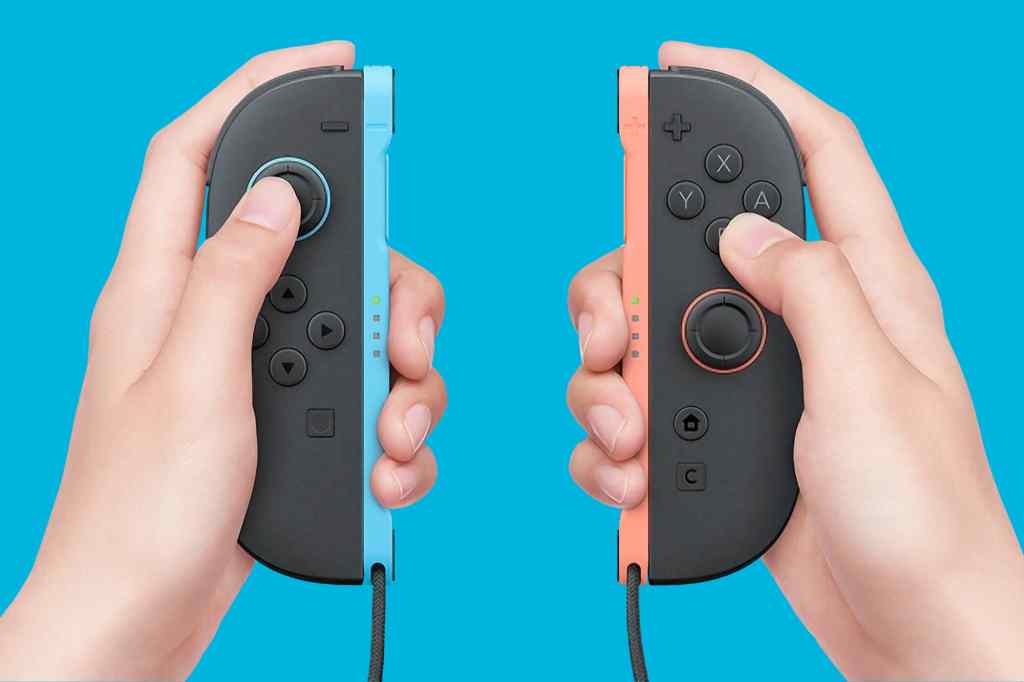
When the Switch first launched, I wasn’t too thrilled about the Joy-Con concept. I wanted them to keep the controls attached to the device and ship a “real” controller in the box. It felt like a compromise to me at the time, but boy am I eating crow now.
The original Joy-Cons were too small for my liking, and the rails that they attached to felt flimsy at times. There’s also the whole issue with the stick drift, but that’s not exclusive to the quirky two-part design here.
Those problems were enough to furrow my brows, but they weren’t even my main complaint. No, my primary issue resided in the core conceit: One Joy-Con in each hand. I was so used to “normal” controllers that I found my inability to free one of my hands at a moment’s notice to be a knockout.
Of course, I could set one down completely, or use a Joy-Con grip to simulate the one-piece experience, but I simply wasn’t happy with the extra steps compared to a PlayStation or Xbox controller. It felt kludgy, so I mostly relied on third-party controllers for the life of the original Switch.
Fast forward to 2025, and many of the minor niggles are alleviated. Joy-Con 2s are bigger, the magnetic attachment style is vastly superior to the rails, and we’ve all just grown used to the stick drift replacement program. I’d have preferred some hall effect sticks, but there are unambiguous improvements nonetheless.
What I didn’t realize until I started playing a lot of Switch 2 is how much the Joy-Cons help me deal with my repetitive stress injury (RSI). If I spend an hour playing my Steam Deck in handheld mode, I end up with some numbness and tingling in my fingers. The Switch 2 has that same problem, but I can easily pop off the Joy-Cons for a much more comfortable experience.
While my own physical ailment is ultimately minor as far as health issues go, the Joy-Con 2s ended up making a noticeable difference for me. This serves as a reminder that controllers or accessories that seem strange or useless at first blush might actually be the difference between someone being able to play a game or being shut out completely.
Joy-Cons are secretly accessibility aids.
I’m confident in my assumption that Nintendo engineers didn’t have RSI at top of mind when they decided to go with the Joy-Con design, but I sure am glad that I can play this portable machine without major discomfort.
Consider this my formal apology: I’m sorry I dunked on Joy-Cons in 2017. They’re actually pretty nifty (even though I still prefer playing with an 8BitDo Pro 2 when docked).
Image credit: Nintendo



 Video Game Town