

The hobby of collecting “Pokémon” cards has gone mainstream again with outlets like the Wall Street Journal reporting how over the past 20 years, “Pokémon” cards have appreciated in value more than the S&P 500.
The fever for “Pokémon” cards is bigger now than maybe it’s ever been. Unfortunately, this has given rise to one of society’s favorite parasites: The scalper. These weasels have been using bots to buy up all the product from large retailers and selling them from 200%-500% markup.
If that rubs you the wrong way, fear not. We here at Video Game Town have some tips and tricks to help you protect yourself from getting scammed.

Note: When determining the value of any sealed product, the best way to do so is to examine how many booster packs are in the product, and then multiply by $10. Any booster pack from a modern set should cost you roughly ten bucks a pop.
Manufacturer Suggested Retail Price (MSRP)
Far and away the best prices you will find on “Pokémon” cards is the Manufacturer Suggested Retail Price (MSRP). MSRP is only relevant when it comes to sealed products — these are cards in official sealed packaging.
MSRP prices will have each booster pack at roughly $5-$7 each. Brick and mortar retailers like Walmart, Best Buy, and Gamestop stock at MSRP prices. The official Pokémon Center website does too. These stores will not rip you off, so they’re pretty safe bets if you can find stock.
Just keep in mind that this typically only applies to their in-store stock — we will cover these retailer’s web stores later in the article. Sadly, these stores are often out of stock due to the high demand. Certain retailers such as Target and Gamestop enforce a purchase limit per customer while others don’t. If you are lucky enough to find any “Pokémon” cards at MSRP price, you’ve really lucked out at this point.

Local Card Shops
The next most-reliable source is your reputable local card shop. Local card shops, or LCSs, are small shops that specialize in selling trading cards. LCSs will often have older sets whereas your big retail stores will only have the more modern sets. However, LCS prices are almost always more expensive than MSRP.
This is where the suggested value of $10 per booster pack comes in. The $10 per booster pack only applies to the more modern sets. Any set older than a year will often cost more. LCSs might also price sets differently depending on how the individual cards of a set, or hits are, selling individually.
For example, The 151 set came out in 2023 and has roughly 11 cards that are selling over $50 at the time of writing. So 151 booster packs can sell at $13-$15 per pack due to it’s age and the individual cards’ perceived values on reseller markets.
Sets that are released in the current year should never cost you more than $10 per booster. The benefit of shopping at a LCS is that they will almost always have some product on sale, and you might find product from sets you’ve never seen before — a great way to grow your collection.

Online Retailers
Here is where things get hairy. Online retailers are where you are most likely to find scams like price gouging, resealed packs, and opened products. And if you’re really unlucky, you might even run across some counterfeit cards.
If you choose to buy “Pokémon” cards online, outside of the $10 per booster rule, it is imperative that you check the smaller retailer’s reviews. I personally feel comfortable if the third party retailer has at a minimum of 400 reviews, and the average review is 4.0/5.0 or higher. I’ve stuck to this number, and have yet to get got.
Now, let’s use the product below as an example:
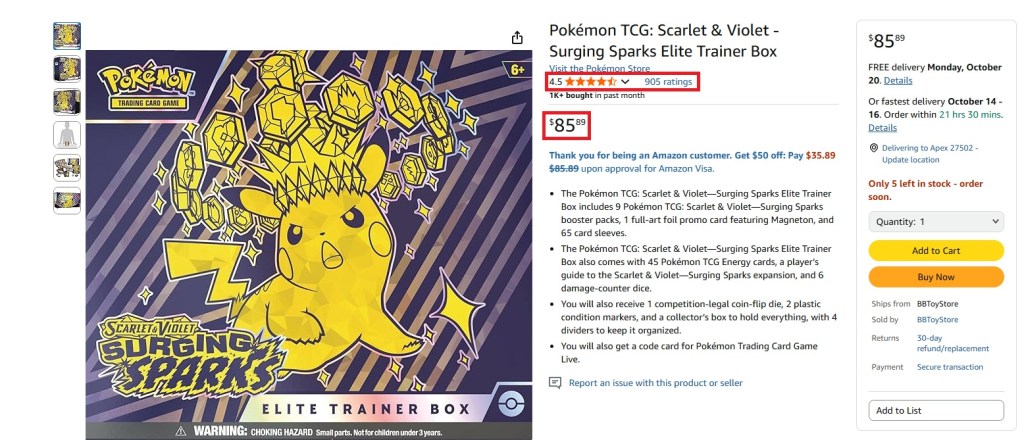
As you can see, this is a listing for a Surging Sparks Elite Trainer Box on Amazon. First thing I check is the price: $85.89. Modern set Elite Trainer Boxes always come with nine booster packs. Nine boosters times $10 = $90. It passes the $10 apiece rule.
Now, I check the reviews. 4.5/5.0 average out of a total of 905 reviews. That is at least 4.0/5.0 with a minimum of 400 reviews so it passes that check. I would trust this seller to not be a scammer.
The final recommendation is to stick with official products. Anything that tries to sell you things like, “50 ‘Pokémon’ cards with 1 guaranteed Ultra Rare” or anything like that, I would avoid. Stick with official “Pokémon” TCG products.
Singles
“Singles” are cards sold individually. They are most commonly sold at LCSs, online retailers, and eBay. Our recommendation for people new to the hobby is to avoid purchasing singles for a while
Buying singles requires you to understand the value of individual cards, know who is a reputable seller, be able to understand and spot issues related to conditions of cards, and be able to identify counterfeit cards. All these things are way over the head of a beginner collector.
Start your collection, understand the hobby a little more, then maybe start dipping your toe in the world of singles after you’ve learned the ropes.

And that about wraps us up on this journey into the hobby of collecting “Pokémon” cards! I hope these articles have given you enough of an understanding in starting your collection, protecting your collection, and not getting ripped off.
If you are interested in more aspects of “Pokémon” cards such as how to identify what kinds of cards are worth grading, a guide to buying singles, or how to track the value of your collection, let us know in the comments. Thank you again, and good luck with your pulls!
Image credit: Kamil Switalski




 Video Game Town