
This guest post is written by Alex Taurozzi.
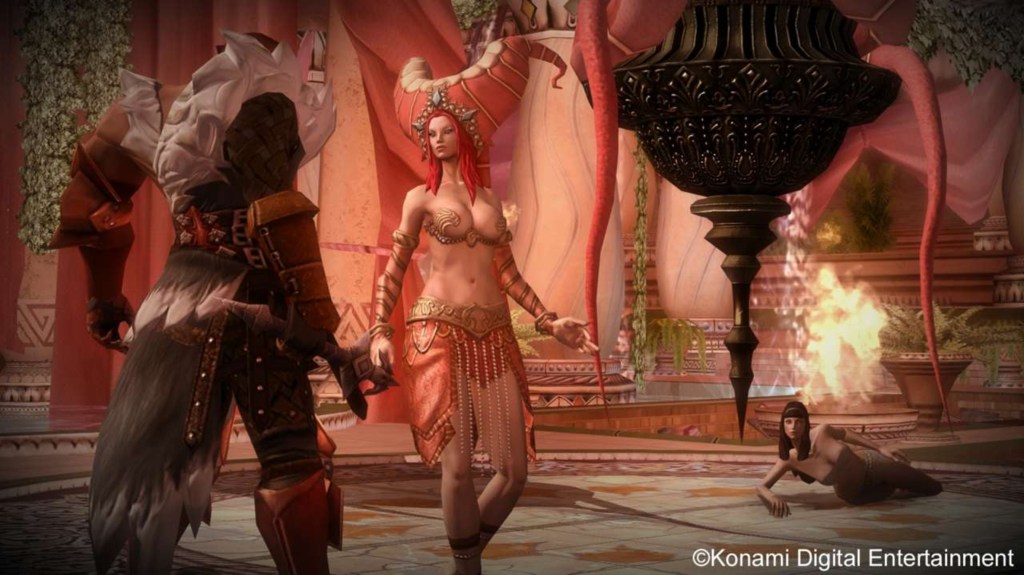
In a long lineage of vampire hunters, the Belmonts seek to destroy evil where it lies. After a brutal showdown, Simon Belmont, heir to the Belmont clan, descends slowly to murder a defenseless red headed woman. Although she is a Succubus, attempting to lure the player with feminine wiles, the camera angle and control to physically kill her is startling.
“Castlevania: Lords of Shadow – Mirror of Fate” is a 2013 action adventure game. The 3DS exclusive (at the time) was the second entry in the “Lords of Shadow” saga. You begin as Gabriel Belmont — soon to be Dracula. Then play as Simon, his grandson; Alucard, his vampire son; Trevor, his human son. The game combines “Castlevania” backtracking with hack-and-slash gameplay; it’s cyclical in both theme and story.
Throughout time, vampirism is a potent allegory. Religious faith, queerness, the lust for greed and power. Generational curses. Trevor arrives in Dracula’s castle to slay his father. He seeks revenge for his dead mother and revenge on Gabriel for bringing shame to the family. Dracula slays Trevor as he realizes his mistake at the end. He does the unsavory act of feeding Trevor his blood. Trevor awakens years later as Alucard, having abandoned his wife to death and his son, Simon, to a live of seeking vengeance.
Each Belmont man seeks to avenge their parents honor. The generational curse is patriarchal — no female Belmont in the revenge murder line. Mothers are dead badges of honor.
There is no real concern for women in this game unless they are dead. The scene of killing the succubus with such intention lingers in my mind. We knew nothing about her life, other than the fact she was a) sexy, b) had a harem, and c) was a consort of Dracula. Sexualized femininity: Historically, the most hated kind. The kind that violence is perpetrated against.
Besides Dracula, Succubus is the only boss with a human face.
We know little of Simon and Trevor’s mothers. We know that A) they are mothers, B) they have sons, and C) they presumably love their husbands. Their actions of note to the narrative is sacrifice. Trevor’s wife, Sypha, goes from traditionally active heroine to reimagined trad-wife. Maria sleeps with Gabriel, has his baby, loses that baby to the Brotherhood of Light. Both characters fulfill the same need: The motivation for the men.
The opportunity for all the Belmonts is to define themselves by vengeance and violence. It is a masculinity that uses femininity to justify their actions. Only when Gabriel kills Trevor do we see tears. Not when Simon remembers Sypha. Not when Trevor sees Simon. Only when violence is exacted do emotions flow.
Dracula’s castle enforces this anti-women sentiment with several images and iconography in the castle. Women are always naked, supplicant to male figures carrying giant swords. Then, there are the bodies littered over Dracula’s throne entry way. Bleeding from their necks and naked, it leaves little to the imagination.
A log from a dead soldier confirms the women were forcefully taken, played with, and then killed and sucked dry — suggestive. Also, one soldier describes Carmila as a “bitch.” “Mirror of Fate” is not concerned with how its female characters lived, but how they die.
IGN stated in their original review that the game had a weak story. They weren’t kidding. “Mirror of Fate” delivers a final message of breaking generational curses, but all the women are treated the same. Mercury Studio continues a tradition from the 15th century in that
women could be witches and should be burned at the stake. Too many entry ways to sin and destruction with their chaotic femininity and tempting role in society. It’s all a very tired trope.
As some women have noted, this seems like every story ever. Which is a shame. “Castlevania” has had female-action oriented characters, both in game and in universe. Sypha, a personal favorite from the anime, is to be of note. These were not sin, but shining lights of heroism.
Simon murdering the Succubus does not redeem his mother or the other women killed in the game. In this power fantasy of murdering, a woman on her knees subjugated to the death blow of a man is concerning. “Mirror of Fate” is openly hostile to women.
But for the game industry of 2013, it was par for the course. Remember that one trophy controversy from “God of War: Ascension?” Same year as “Mirror of Fate.” It’s not a coincidence, this is an industry bogged down in the quagmire of misogyny, Gamer Gate, and repressed male sexuality and toxic fanbases.
Image: “Castlevania: Lords of Shadow – Mirror of Fate,” Konami Digital Entertainment

 Video Game Town