

This guest post is written by Paul Frew.
I’ve often wondered if I were a private detective in another life. I don’t mind a shot of bourbon, I think I can pull off a trench coat, and I’m constantly hoping my next big payday comes knocking at my door. It might also be why I’m drawn to detective games like “Obsidian Moon.”
Not only did I get to play the demo (available now on Steam), but I got to chat with Yannis Antonakakis, the Game Director at Lost Cabinet Games. He also happens to share my love for detective games.
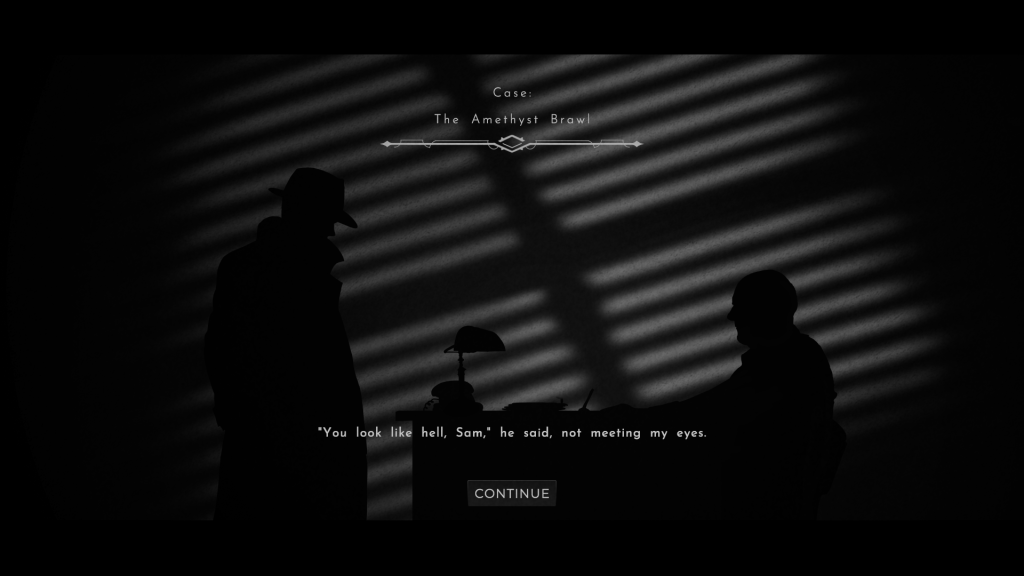
“From crime literature to movies and video games, I love the genre because of atmosphere, mystery, and all the a-ha moments,” explains Yannis. “Who doesn’t love trying to find the culprit early in the story and feeling the satisfaction at the end when your detective hunch was right?”
No Disco. No Elysium.
“Obsidian Moon” is a text-based adventure set in the fictional Obsidian City. You play the role of Sam Carter, a former homicide detective who’s down on his luck. He has all the traits of a classic P.I.: bloodshot eyes, whiskey sweats, and an ex-wife. The game opens with a former colleague handing Carter a second chance. He’s tasked with solving a series of interconnected murders. At the same time, he’s trying to balance his budget and sanity.
The demo includes two cases. The first is a tutorial that shows you how the game works. You’re investigating a murder at a dingy basement bar where the owner has locked the killer inside. It should be an open-and-shut case, right? Not quite.
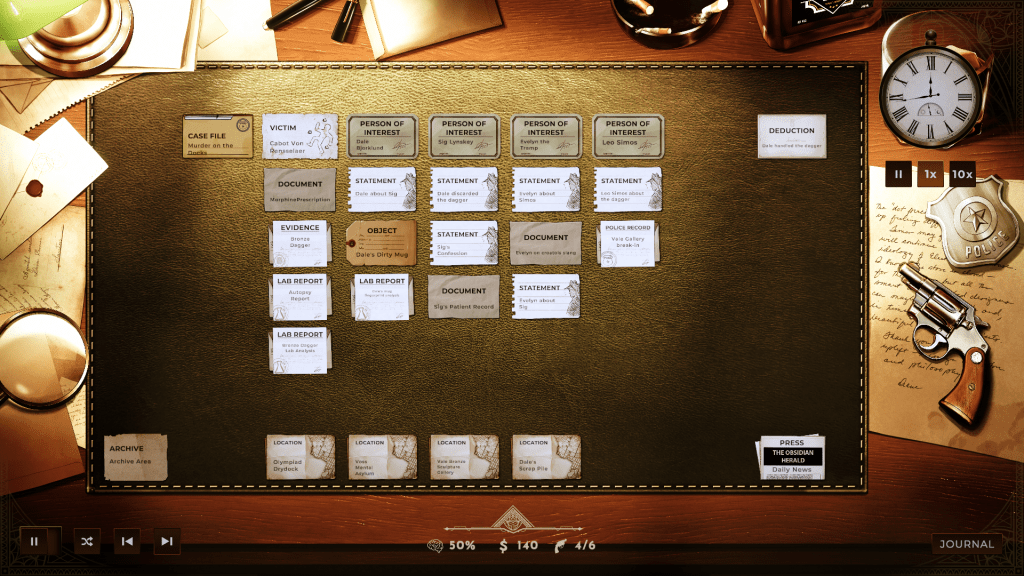
Once you start investigating, it looks like you’re a desk jockey pushing papers, but you’re not. Your desk is where you lay out everything you know about the case. It’s also where you organize lab results, surveillance on suspects, and interview transcripts. Keep in mind that the game is set in the 1930s, so forget about calling in the CSI lab. You’re going to have to solve it the old-school way.
As clues surface and information unfolds, cards appear that help you link motives and eliminate suspects.
“There has been a significant amount of research on case structure,” says Yannis. “For example, consider Agatha Christie’s Hercule Poirot versus Jo Nesbo’s Harry Hole. Both great detectives, but their investigative approaches and styles are totally different. Christie’s case structure is typically a ‘whodunit’ while Nesbo’s is more legwork-oriented. ‘Obsidian Moon’ has a central dark theme that drives all murder cases. This isn’t exposed until later in the game. It employs a unique approach that allows the player to apply their own investigative style.”
Play It Again, Sam
After replaying the second case multiple times, I can see what Yannis means. On my first playthrough, I took a stab at who the murderer was. It turns out I was wrong, and the false accusation tanked my sanity meter. I also skipped out on paying my investigative bills, which didn’t help.
The second time I approached the case, I analyzed all the evidence and uncovered every clue I could find. This made it easier to pin down the culprit. When I got my results at the end of the case, I’d still missed a few clues, but I picked the right suspect and kept my sanity in check. I still chose not to pay my bills.
“Replayability was not our original vision, but a much-welcomed by-product of our design choices,” says Yannis. “To date, I do not know of anyone closing a case with 100% of the clues revealed. I would certainly like to know if someone does it.”
The full game will feature 10 murder cases with over 30 possible solutions. There’ll also be optional side cases if you’re not ready to hang up your fedora. Completing them will unlock key backstories that help unravel the entire mystery. “Obsidian Moon” will also include difficulty modes to challenge real sleuths. The hardcore mode adds permadeath, which would probably get me to pay those bills on time.
Under a Killing Moon
What stood out most to me while playing “Obsidian Moon” was the atmosphere. Even though you’re staring at a desk with a bunch of cards on it, the score oozes a classic detective vibe. I’m talking about the distinct sound of a bass slap and brass instruments wailing with sadness. I feel like I can smell the old leather on the desk, the empty bourbon glass staining the surface, and the stale remains of the last cigarette from the pack.
Lost Cabinet Games has even added a Noir Mode that takes this experience to another level. Everything turns to black and white, and the music sounds a little scratchier. It’s like you’re listening to a record on a gramophone while rearranging clues on the desk.
“Atmosphere has been fundamental to the design of ‘Obsidian Moon,’ especially given that it is a text-based experience,” explains Yannis. “We want the player not just to solve a case, but also to feel part of a dangerous world. We approach world-building the same way that H.P. Lovecraft does: the horrors are implied and never explicitly shown. Music, sound, visual effects, and especially the storyline need to be absolutely spot on to convey the atmosphere and complement the narrative.”
“Obsidian Moon” launches in 2026. The demo is available now on Steam.
Image Credit: “Obsidian Moon,” directly from Lost Cabinet Games


 Video Game Town
Leave a Reply