
Christopher Nolan has arguably never made a bad movie, but his filmography is experienced, by each time-slipped audience member, in relative terms. One might reasonably have a ranking the exact opposite of someone else, yielding a fitting palindrome; whatever the case, it’s now a sprawling-enough oeuvre to demand spirited debate.
Although synonymous with large-scale spectacle, the British American director has also made intimate, shoestring productions of varying lengths, upon which he would build not only in scale, but style and intent. However, as with any auteur, one can trace his creative DNA between projects. So, as much as this may be a ranked list, it’s equally about the elements of his work that cross-pollinate across the decades, to varying degrees of success.
The result is a fascinating repertoire that has re-defined Hollywood over the last twenty years. It has flung Nolan far and wide in terms of fandom — he is, for instance, wildly popular in India — while also generating curiosity about what concepts he might tackle next, through his broad-but-elevated sensibilities. This particular list covers not only his thirteen features, but a trio of short as well, dating back to 1989 but spanning as recently as 2015. The only omission is his 1996 crime caper “Larceny,” which, at the time of writing, remains intentionally buried. However, with his latest now in theatres (and the others mostly available to stream), there’s no dearth of Nolan movies to enjoy.
16. “Insomnia” (2002)
The bottom rung on the Nolan ladder remains fascinating for its stylistic seeds. An imperfect remake of a Norwegian neo-noir, “Insomnia” is the only film on this list not written by Nolan, though it bears some of the chaotic, impressionistic editing (courtesy of Dody Dorn) that would carry through much of his career — all through his Greek epic “The Odyssey.” The plot follows Detective Will Dormer (Al Pacino) who, after accidentally shooting his partner mid-chase, is plagued by sleepless guilt in a perpetually sun-lit Alaskan town.
This bodes well for neither the young protégé who idolizes him (Hillary Swank), nor the alleged killer he’s determined to catch (Robin Williams) no matter what lines he needs to cross. It makes for a decent psychological thriller, though its moral edges are sanded down compared to its murky predecessor, leading to an emotionally constricted story.
15. “Doodlebug” (1997)
A delightful three-minute university experiment — and the second of several collaborations with actor Jeremy Theobald — Nolan’s “Doodlebug” lays the foundation for his approach to layers of reality, in the form of a mise en abyme. In a mysterious apartment, a man chases an unseen critter only to find that it’s a miniature version of himself, and is obsessed ,in the exact same way, with catching something even smaller. The slight delay between the creature’s mirrored actions and his own are where the movie’s playful tension breathes, dramatizing the idea that time, and perspective, are insurmountable borders that might lead to self-destruction.
14. “Quay” (2015)
On the surface, Nolan has little overlap with eerie stop-motion mavericks Stephen and Timothy Quay. However, a closer read of the twins’ movies reveals thematic similarities concerning dreams and cityscapes. It’s no surprise, then, that Nolan’s 2015 documentary short — a far cry from the blockbuster era he was firmly in — takes a tender approach to two filmmaking veterans he admires. It is, for all intents and purposes, merely an eight-minute tour of their workshop.
But rather than revealing the method to their madness — their magician-like secrets — Nolan’s true focus is the intangibles of their creative partnership (an understandable curiosity given his work with his own brother, screenwriter Jonathan Nolan). The two idiosyncratic figures speak practically as one, through a soundscape that emphasizes their overlapping thoughts and opinions without attempting to decipher which one of them is talking. It’s concise, but in its own way, magical.
13. “Following” (1998)
Shot across several weekends on 16mm stock, Nolan’s first feature follows a habitual stalker (Theobald) whose suave, Bond-like mark (Alex Haw) turns the tables on him, before roping him into an amusing saga of breaking-and-entering. Told through a tri-pronged narrative, the mystery film is Patient Zero for Nolan’s nonlinear storytelling about duty-bound men, albeit without rigorous motivation to skip between the timelines. Still, the movie’s winking reliance on familiar noir tropes — like a shifty femme fatale (Lucy Russell)— speaks to a novice director intent on not only re-creating the images of his youth, but reshuffling them in revealing ways.
12. “Tarantella” (1989)
Co-directed with Roko Belic — and, uniquely, starring Nolan himself — the surreal Super 8 short “Tarantella” (which aired on PBS) is the least Nolan-like of Nolan’s movies. It tells of a man plagued by abstract, nightmarish visions of a spider and several other disturbing things; cue the Brothers Quay comparisons! However, if “The Odyssey” is anything to go by, then a full-blown horror feature might not be out of the question for the action maestro, which would make revisiting this gem especially intriguing in the years to come. As Nolan’s first credited work, it’s a clear sign of how point-of-view and sensory experience were some of his earliest fixations, which have carried over to his studio films with increasing bombast.
11. “Batman Begins” (2005)
A stripped-bare origin steeped in remorse, “Batman Begins” set the mid-aughts template for supposedly darker, gritter reboots, but its lavish mischief is undeniable. Few superhero films have so captured not only the psychology of survivor’s guilt, but the texture of a folkloric place like Gotham, thanks in large part to a dedicated ensemble — including Gary Oldman as Commissioner Gordon and Michael Caine as Alfred Pennyworth — who make the city feel real and alive. Although the movie fumbles its own moral core right near the end, it remains infinitely rewatchable thanks to Wally Pfister’s atmospheric cinematography and a chilling score by Hans Zimmer and James Newton Howard, who lace the idea of fear into every note and frame.
10. “The Prestige” (2006)
An impeccable matryoshka doll narrative told through diaries within diaries, “The Prestige” crystalizes the kind of obsessive, duty-bound protagonists (played here by Hugh Jackman and Christian Bale) who would become common in Nolan’s films. A Victorian period piece about competing stage magicians, the movie asks up front, “Are you watching closely?” only to still perform multiple rugs pulls, as acts of deception begin to exist half way between survival mechanisms and works of self-destructive art. As a follow-up to the globetrotting production “Batman Begins,” it’s also Nolan’s first film to capture the anxieties of a young father taken far from his family, trying to make his way back home, much like his flawed heroes — a theme that would come to define his work.
9. “The Dark Knight Rises” (2012)
A film that brings Nolan’s best and worst instincts into collision, the plot of his superhero trilogy capper is political hodgepodge, but its underlying story is one of visceral, deeply-felt hope against all odds. A tale of urban warfare, “The Dark Knight Rises” wasn’t Nolan’s first nine-figure production, but it was arguably his first true big-screen epic, with archetypes engaged in the roaring, operatic drama of entire cities and peoples in motion, captured with the grandeur of the IMAX frame. Good billionaires won’t save us, but unfettered optimism might.
8. “Dunkirk” (2017)
A work of shifting modalities, Nolan’s first World War II movie proved his non-linear approach could fit practically any concept. With the help of Zimmer’s cerebral score, and editor Lee Smith’s uncanny ability to conjure crescendos from any footage on his timeline, the dialogue-light “Dunkirk” turns a real survival saga into a tale examining the effects of time on human perspective. As young infantrymen count down the days on an unforgiving beach, a rescue trawler faces the disorienting expanse of open waters, while a fighter plane runs out of fuel over the course of an hour.
Time becomes both enemy and ally, in a simultaneously condensed and outstretched work of titanic destruction, which pulls from all the familiar hallmarks of war cinema, but uses them to scrutinize history in the process, and the political machinery that sends young men to die in service of words and ideas.
7. “Memento” (2000)
Whether superheroes or historical figures, Nolan’s heavily-mythologized protagonists are ultimately products of self-mythology, a concept he explores (and explodes) from the inside out in “Memento.” A story of revenge and retrograde amnesia, its tattooed roadmaps and interlocking, backwards-and-forwards structure dramatize the disorientation of memory loss, while its wry neo noir protagonist Leonard Shelby (Guy Pearce) concocts the ultimate espionage saga in the California sprawl: trying to track down his wife’s killer based on clues he doesn’t remember leaving himself. The result is an intuitive, emotionally-driven puzzle box of lies and delusions that imbues the mundanity of domestic life with the allure of violent fantasy.
6. “Interstellar” (2014)
Adapted from his brother’s more linear screenplay, Nolan’s sprawling space odyssey overcomes its clunkiest, most verbose moments to deliver an open-hearted action tome on the things that connect people in a dying world. Another film that literalizes regret and memory, it uses time travel, relativity and a doomed galactic adventure to tell a wrenching tale of a father (Matthew McConaughey) duty-bound to leave his children behind, and all the emotional complications therein. A follow-up to the contradictory politics of his Batman threequel, it takes on a more egalitarian bent, as Nolan teams up for the first time with cinematographer Hoyte van Hoytema, who grounds even the heavenly Church organs of Zimmer’s score in a grungy, lived-in reality. It may be set in the future, but it’s distinctly about the now.
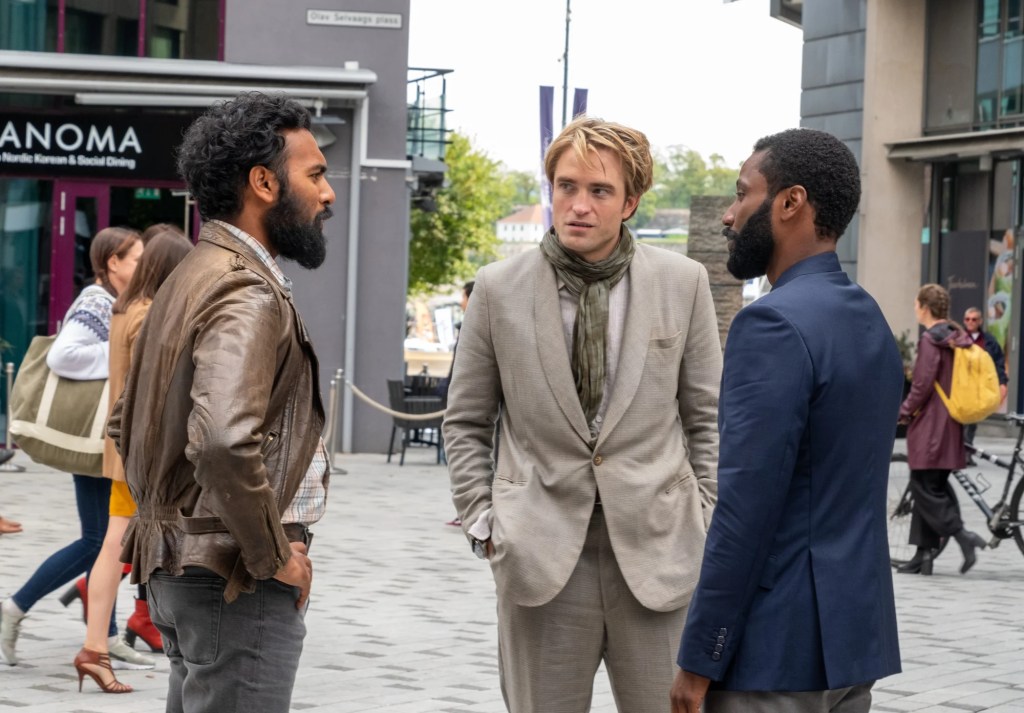
5. “Tenet” (2020)
Where our phantom descendants take benevolent form in “Interstellar,” “Tenet” explores the other side of that coin, imagining a mind-bending world where their fury at our environmental failures stream back at us through time. A globetrotting spy caper that folds atop itself, Nolan’s visceral bombast finds perfect companionship alongside van Hoytema, musical virtuoso Ludwig Göransson, and ace editor Jennifer Lame — his new regulars — resulting in a story where, at the midpoint, an unnamed protagonist (John David Washington) becomes so hell-bent on his altruistic mission that he goes backward through the movie we’ve just seen.
While its mechanics make perfect (albeit headache-inducing) sense from a physics standpoint, its entropy-inverted antics are best experienced with the movie’s own advice in mind: “Don’t try to understand it. Feel it.” And, on an enormous 70mm IMAX canvas, what’s most felt about the film is its naked, romantic notions of duty and care being able to save the world.
4. “The Dark Knight” (2008)
A pop culture lighting rod, “The Dark Knight” captured the sense of widespread paranoia felt in the wake of September 11th and transposed it onto a clown-like terrorist, embodied by Heath Ledger’s immortal performance. A film of technological warfare and state surveillance, it plays out in a constant state of climax, making the modern popcorn movie equally gloomy and exciting.
It cemented Nolan as not only a virtuoso of populist action, but a deft purveyor of montage as an emphatic curtain call, threading the needle between his themes of the power of duplicity and narrative myth — a trick that would recur across subsequent films. The first feature to use IMAX cameras, not only was it a foundational blockbuster for Nolan’s career, but proof that in an increasingly homogenized era of Hollywood, blockbusters could still feel foundational.
3. “Inception” (2010)
In Nolan’s dream-within-a-dream world, the hero is the director, and his heist is emotional catharsis. A personal vision of action filmmaking rooted in grief and guilt, his elevated Bond saga wraps his many fixations — with time, self-mythology, and the long journey home — around mechanics aimed at the illusion of simultaneity. Everything from Smith’s meticulous editing to Zimmer’s booming score is aimed at creating peaks and valleys that ripple across layers of consciousness, in an effort to create a complete cinematic experience that plays by the emotional rules of cinematic creation.
2. “The Odyssey” (2026)
With his latest, most thundering film, Nolan reaches back into the source code of western storytelling — a nearly 3,000-year-old Homeric epic — but adapts it for his modern concerns of Christofascist empires, and a world hell-bent on self-destruction. It’s as though he were re-writing his own creative DNA. “The Odyssey” builds on the chaotic stimuli that were once connective tissue in his movies, and turns them into his cinematic lingua franca.
All the while, he employs the enormous IMAX frame for its sprawling intimacy, resulting in a film of tremendous thought, reflection and visceral sensation, as his conflicted Odysseus (Matt Damon) journeys reluctantly homeward in a story of original sins and the broken bonds between societies at the end of the Bronze Age. Through notes plucked one at a time by Göransson, the tale becomes a grandiose lament for a broken world, moving and rousing in equal measure.
1. “Oppenheimer” (2023)
A war biopic that plays like an explosive thriller, “Oppenheimer” both breaks new ground for Nolan — it’s a film of competing legal testimonies imbued with heft and vitality — while building on all the ideas and techniques he’d gradually mastered throughout his career. Not only is it a miraculous adaptation of a sprawling biography, one that condenses entire chapters into single exchanges, but it wrestles in the mud of historical, cultural and political paradoxes, the kinds of opposing forces that allow people to compartmentalize and justify atrocities. The film is unrelenting in its construction of relationships, which in turn bring people closer to personal and global oblivion by way of the Manhattan Project, a nearly 3-hour voyage painted across on an enormous canvas that refuses to let us look away from our own reflection.
Image credit: “Tenet”
This guest post is written by the best in the business, world class film critic Siddhant Adlakha. Also, as his editor, I have to say “The Prestige” is way too low, “The Dark Knight Rises” is too high, and “Interstellar” is overrated.



 Video Game Town
Leave a Reply