
This guest post is written by Katya Ryabova.
A fortunate sequence of events, mostly reposts on Bluesky, led me to the as-of-yet little-known, gorgeous-looking release called “The House of Hikmah.” Made by a globally-distributed indie team called Lunacy Studios, the game is their first. Its core premise centers on a young girl in the aftermath of a profound loss, explored through puzzle platforming and object-altering mechanics that the game builds up on as you go.
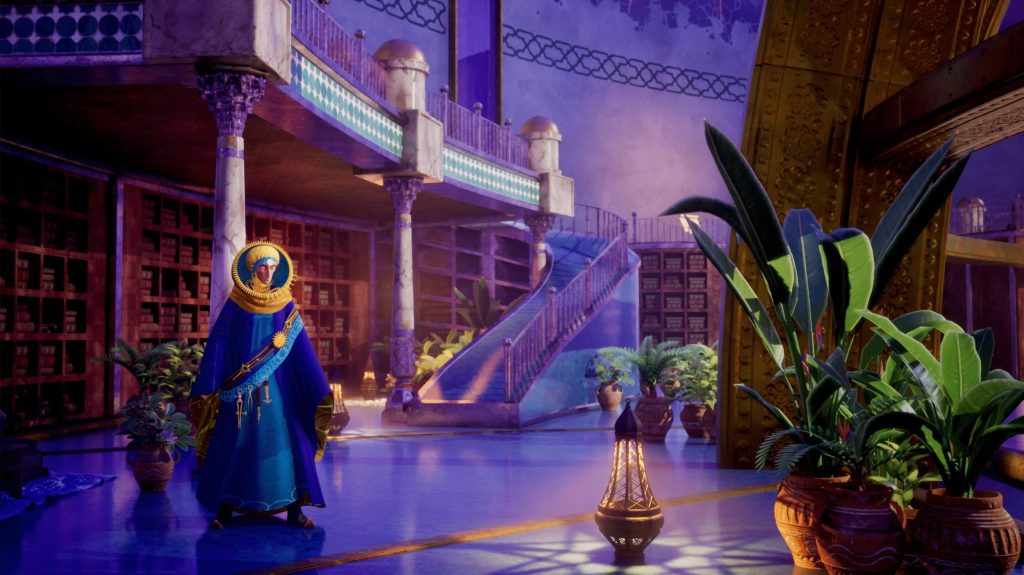
Equally as prominent and important to the game is its setting in the mystical House of Wisdom. The Islamic Golden Age is the inspiration for its appearance and inhabitants, supplying the supporting characters, the lush tapestry of the game’s visuals, and the areas of expertise of its Scholars, all based on real historical figures of science and art.
Within the confines of the House lie many domains that hide the universe’s many mysteries. One of their most intrepid explorers is Abdullah, a scholar and navigator, whose young daughter, Maya, has to set foot in the House after his death to help her understand the legacy he left for her. Each domain Maya enters is a separate area with a distinct level design, domain-specific puzzles and mechanics, and, to the point, an opportunity to unlock a new power. These powers allow her to traverse the world, complete errands for the Scholars, and be a witness to their grief while initially refusing to deal with her own.
The themes of grief are nothing new in video games, but a father-daughter relationship forever changed by it hits close to home. As someone grieving her father, too, I was initially put off by a seeming lack of emotion displayed by Maya. My own judgment surprised me, given how often over the years since my father’s passing I’ve heard that grief looks different for everyone. Remembering that delivered an emotional payoff as I worked through the game. When I reached its somewhat expected, but hopeful, conclusion, I was way more on board with “The House of Hikmah” than when I started.
That sense of hope and the ability to live with grief, rather than letting it consume you, is what folks at Lunacy Studio want players to take away from the game. “We want players to experience a short, but memorable journey through shadow and into light, while remembering those who shape who we are today,” say Elizabeth Litvitskiy (Producer) and Micaela Dawn (Art Director). “If players were going to take one message from the game, it would probably be one of hope and legacy intertwined.”
Playing the game is a chill experience. The puzzles get clever as Maya gets more powers to figure them out, but they never challenge to the point of frustration. The puzzle design reminded me most of “Portal,” except more whimsical and much less intense, heavy themes and foreshadowing notwithstanding. The price of failure in the House is nil — failing a platforming jump respawns you right where you were to try again. While many players have reported bugs, and the team already released two major patches to squash them, I only encountered one in my playthrough, and the game ran well overall on my mid-range gaming PC.
“The House of Hikmah” is short. It took me about six hours to complete the game, while taking my time to admire the scenery. The dazzling, colorful design of every Scholar’s domain, with meticulous attention to detail, is a feast for the eyes. I spent a good deal of time walking around the levels admiring the tapestry, the fainting couches, the hanging lamps, and the latticed gates. The setting really makes the game, even more so than its puzzles and a straightforward story. “We all have a passion for celebrating the beautiful region and the scholarly legacy that inspired the setting,” note Litvitskiy and Dawn.
The game is fully voiced in both English and Arabic, inviting the player to choose whichever they feel drawn to. There is gentleness inherent not just to the game’s themes and its treatment of the subject matter, but in how it addresses the player and approaches its level design. This gentleness is what keeps me thinking about the game.
Some players may have an issue with its length or performance, or ignore a game not rooted in Western history, traditions, or art. I hope you won’t be one of them. “The House of Hikmah” is a beautiful puzzle platformer of just the right length. It doesn’t outstay its welcome; it doesn’t preach; it gives you a perfectly contained gaming experience that will resonate with folks no matter what language they speak or what clothes they wear.
Grief is a universal experience indeed.
Image Credit: “The House of Hikmah”



 Video Game Town