
This guest post is written by Kelsey Nichols.
There are some games where, when you play them, they stick with you for the rest of your life. Not because of some innovative gameplay mechanic, or flashy graphics that won’t look nearly as good as you remember them in even ten years, but because of the person’s shoes they put you in.
“Crisis Core: Final Fantasy VII” is one of those games.
Originally released for the PlayStation portable in 2007, this prequel to the 1997 classic “Final Fantasy VII” the game is a departure from the traditional mores of the franchise and the “VII” Compilation both in its gameplay style and its storytelling structure. While the game has been controversial within the fandom of the “Final Fantasy VII” Compilation since release for those exact reasons, they are also what have left an enduring impression on those who truly love the game for what it is.
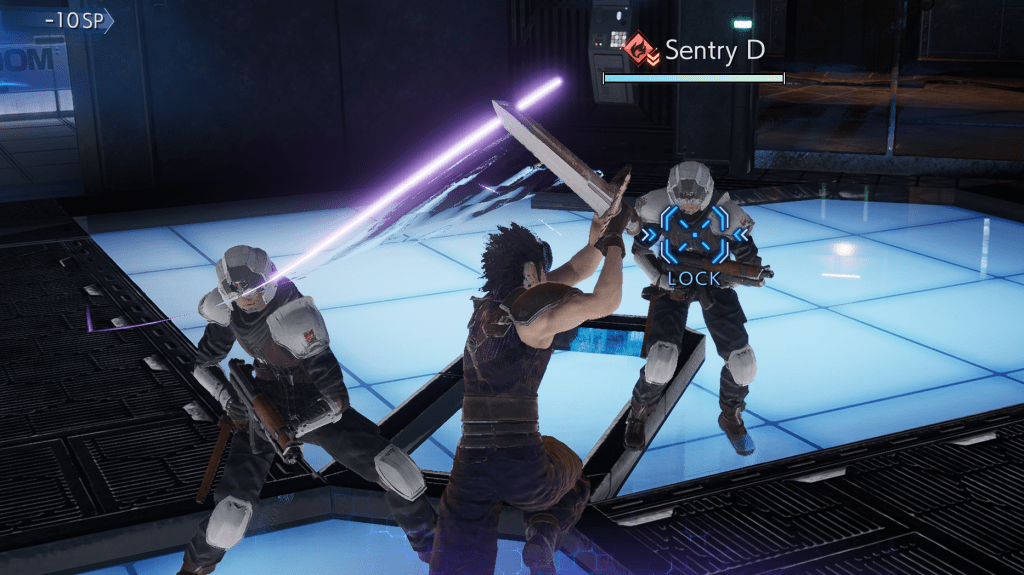
A major part of this is the way the combat system is utilized as a storytelling device. Unlike in “Final Fantasy VII,” your limit breaks and summons are not bound to a command in a turn based system or to the amount of damage that you’ve already sustained. Instead, there is an element of randomness at play. The Digital Mind Wave (DMW) system is a slot machine-like mechanic that appears at the upper left corner of the HUD during combat.
Invisible during encounters, the protagonist Zack Fair accrues “Soldier Points”. Once you get ten, the DMW system will engage. At first, the characters will be shown only through their silhouette. As you progress through the story, they will appear properly. If the slot machine fails to line up, Zack will receive bonuses, such as temporary unlimited magic points in combat. If they do, you will get to perform the associated summon or limit break for additional damage on your foes.
The beauty of this system shines through as you meet the associated characters. The DMV system is canonically based upon Zack’s memories. As a result, when the limit breaks associated with characters line up, you’re treated to a short cut scene that involves Zack’s interactions with that character outside of the main story. At times, due to the nature of the characters Zack meets and when he does so, these cut scenes can provide further elucidation on the events of the story itself, as well as the progression that the characters might have experienced together before the events of the story take place.
Through this system, you are treated to a perspective on the protagonist that isn’t commonly replicated in other games, if at all. The flow of battle is interrupted not for a pointless cutscene, but to help you to better get into the head of the person that you’re playing as.
Of course, this is all cemented by the ending of the game. Those who initially played “Final Fantasy VII” know the fate of Zack Fair going into “Crisis Core.” A prequel cannot change events that are already well established by prior media. Yet all the same, the work that the gameplay and DMW memories do to build the character up in the mind of the player leaves the majority feeling off guard as the ending approaches. During the final battle of the game, the DMW takes a center stage that you don’t immediately pick up on. The final battle sequence of the game is the most active that you will ever see that roulette wheel on your HUD. At first, this feels as though the player is receiving more benefits than usual.
Until it doesn’t.
As it becomes increasingly apparent that the final battle is completely hopeless, that no matter what you do, you are fated to lose, the DMW begins to react accordingly. The system begins to visibly glitch, and the associated memories become blurrier and more distorted. Eventually, they begin to focus solely on Aerith Gainsborough, the love interest of the protagonost whose relationship had steadily developed throughout the game. But even those memories aren’t enough to hang on.
No matter what you do, no matter what you try to hang onto as desperately as you can, you lose the battle.
Unlike the majority of other games where the protagonist meets his end, “Crisis Core” puts you directly into the final thoughts of a dying man doing his best to return to and protect those he loved. When put into the context of the other memories shown to the player through the DMW system and Zack’s development as a character over the course of the game, one cannot help but to feel something when witnessing those final moments. The game is designed by that point to make you feel very much like Zack would have – raging against the inevitable and wanting nothing more than for a way to achieve some other outcome.
“Crisis Core” excels in the extent that it makes the player feel as though they have genuinely gotten to know Zack Fair as a person. The game is structured such that you see his growth as a man, his likes, his dislikes, and his fatal flaws on full display through the very memories that he carries with him into battle.
Most games that put you into the perspective of the protagonist do so in a way that shows you, rather than tells you. For example, through narration from them over the main cutscenes, or through diary entries. “Crisis Core” breaks from this trend through the cinematic method of showing the audience through Zack’s perspective, rather than telling them what he thinks and feels. And due to the random nature of the slot machine like system, you will never experience him and his story the exact same way twice, much like your memories of a person who you know well will morph and shift over time as you gain in years, wisdom, and new perspectives.
And in the end, this is what made the game leave an enduring impression on the minds of fans and detractors alike. Whether you like Zack and his story or hate him, you cannot complete the game without on some level feeling as though you intimately know him as you might a friend who died tragically young and could have been much more. The creative use of flashbacks in this way enables “Crisis Core: Final Fantasy VII” to tell its story in a masterful, character driven way that has never been replicated exactly since.
Image Credit: “Crisis Core: Final Fantasy VII”

 Video Game Town