
This guest post is written by Israel Temmie.
The first thing I remember about “Dark Souls” isn’t the screen fading to black, or the heavy, metallic thud of my character’s corpse hitting the stone floor. It’s the quiet, suffocating confusion of walking into the graveyard near Firelink Shrine.
Like thousands of other players who picked up the game with nothing but rumors of its brutality to guide them, I assumed the path filled with brittle, chattering skeletons was the only way forward. Within seconds, I was being systematically cut down by enemies that felt impossibly, unfairly strong. I died. I respawned at the bonfire, dust clearing from my eyes, and went back. I died again. For a brief, bitter moment, I sat in the dim light of my living room and wondered if the game’s reputation for difficulty had actually been understated. I wondered if I just wasn’t cut out for it.
What I didn’t realize, and what the game stubbornly refused to tell me, was that I wasn’t supposed to be there yet.
There was no pop-up warning message. There was no immersion-breaking level recommendation hovering over the skeletons’ heads, and no glowing yellow GPS marker painted across the dirt to point me toward the upward aqueduct. The crucial piece of information I needed wasn’t hidden in a menu; it existed entirely within the ecosystem of the world itself. If an enemy takes five minutes to die and kills you in one hit, the world is whispering, Not yet. I simply hadn’t learned how to listen. Critics have long noted how this hands-off design philosophy defines the brilliance of From Software’s level design, a topic deeply explored in Eurogamer’s analysis of “Dark Souls’” world layout.
That early, agonizing blunder captures something “Dark Souls” understands remarkably well: confusion and true discovery are fundamentally inseparable.
Many modern video games treat player uncertainty as a design flaw, a burning fire that needs to be extinguished as quickly as possible with tutorials, companion dialogue hints, and map icons. “Dark Souls” treats uncertainty as the entire point. It operates on a rare, radical trust. It trusts that you can handle being lost. It trusts that through experimentation, failure, and sharp observation, you will gradually develop your own literacy of its world.
Sometimes, that process feels deeply unfair. It makes you want to throw your controller against the wall and walk away entirely. But more often than not, it creates something permanent. Years after finishing the game, I can barely remember the generic quest markers or checklist objectives of the massive open-world games I played last year. Yet, I remember wandering into the Catacombs entirely unprepared with vivid, crystalline clarity. The memory sticks because I had to earn my way out of it.
The architecture of curiosity
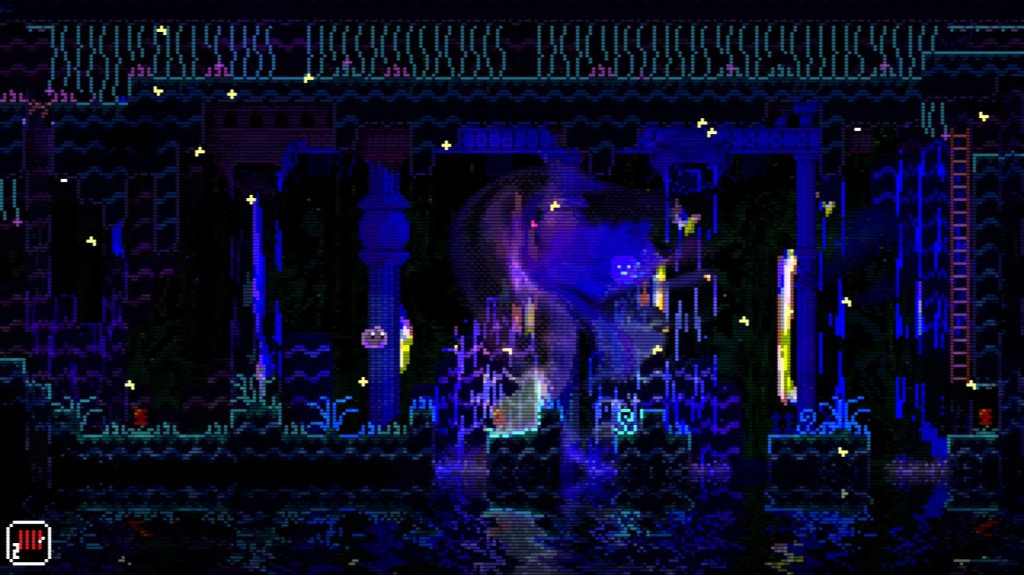
Recently, I found myself chasing that exact same phantom feeling, though through a completely different lens, while playing “Animal Well.”
On paper, “Animal Well” sounds like a familiar weekend project. It’s a beautifully rendered, side-scrolling exploration game built around neon-soaked pixel art, environmental puzzles, and a utility belt of unusual tools. But in practice, it is a psychological labyrinth. It is a game that constantly, brilliantly encourages you to question whether your own eyes are deceiving you. This layered approach to mystery has earned it immense critical acclaim, detailed thoroughly in IGN’s comprehensive review of “Animal Well.”
The first time the credits rolled across my screen, I breathed a sigh of relief, stretched my legs, and assumed I was finished. I thought I had solved the maze.
Then I went online. I started seeing other players discussing things I had never encountered, using words that sounded like a foreign language. They were talking about hidden rooms I had walked right past, strange tools I had never found, and layers of cryptic puzzles I didn’t even realize were puzzles in the first place. I went back to my save file and looked at the map. Suddenly, the solid walls I thought defined the boundaries of the game felt like thin curtains.
Without spoiling the architecture of its deepest mysteries, the magic of “Animal Well” lies in how effortlessly it transforms a sense of certainty into profound curiosity. Moments that seem like definitive conclusions are revealed to be mere starting points. Finding a solution to a puzzle doesn’t grant you a clean sense of closure; it simply unlocks a doorway to a dozen new, more frustratingly beautiful questions. The game manages to feel infinitely larger than its physical map because it occupies so much space in your own imagination. This design framework has sparked fascinating discussions among game designers, as highlighted in Game Developer’s exploration of non-linear mystery design.
What fascinated me most wasn’t just the game itself, but how we, as a community, reacted to it.
The social side of being lost
In the modern gaming landscape, our collective instinct is to optimize the fun out of everything. When a massive blockbuster releases, an entire ecosystem of content creators, wiki editors, and guide writers races to break the game down into its mathematical components. Before a game has been on store shelves for forty-eight hours, there are already thousands of articles explaining the “Best Early Game Build,” the fastest progression routes, and how to avoid ever getting stuck. We have been conditioned to treat video games like data spreadsheets to be solved efficiently rather than spaces to be inhabited.
But with “Animal Well,” something different happened. For a moment, the optimization machine jammed.
Instead of looking up the answers, players gathered in digital spaces to swap notes, compare bizarre observations, and collectively document their confusion. Some secrets were unraveled by brilliant individuals staring at their screens past midnight, but the grander, more terrifying mysteries required a hivemind. It required hundreds of people pooling data, testing absurd theories, and treating the game like a digital archeological dig.
That collaborative madness took me right back to the early days of “Dark Souls.” I remembered the years players spent passionately debating obscure lore fragments, trying to map out the tragic connections between characters who only spoke in riddles, and reading the flavor text of dirty leather boots just to understand the history of a fallen kingdom. This culture of collaborative excavation is preserved beautifully across community repositories like the “Dark Souls” Fextralife wiki, which remains a testament to years of collective theory-crafting.
In both of these instances, confusion ceases to be a lonely, frustrating experience. It becomes social. A game deliberately refuses to explain its own rules, and in doing so, it forces human beings to look at one another and start talking. The silence of the developer births the voice of the community.
What we lose when we know everything
This dynamic feels increasingly rare, and perhaps that’s why I find myself clinging to it so tightly. I am as guilty of breaking the magic as anyone else. I keep a smartphone next to my controller. When a puzzle bogs me down for more than fifteen minutes, or when I can’t find the final collectible in a dungeon, the temptation to pull up a guide is almost overwhelming. I use those resources because life is short, my free time is limited, and getting stuck can feel like a waste of an evening.
But looking back at my history with this hobby, I have to ask myself: what gets lost when every single question has an answer waiting just a few clicks away?
When we scrub away all the friction from our media, we also scrub away the texture. Part of what made my initial, disastrous journey through Lordran so deeply memorable was the genuine, frightening reality that I had no idea what I was doing. I was vulnerable. The victories felt intoxicating because the threat of being permanently lost was real. Similarly, part of what made “Animal Well” feel like lightning in a bottle was the exhilarating realization that everyone else was stumbling around in the dark at the exact same time I was. We were all blind, and there was a strange comfort in that shared blindness.
For a brief, fleeting moment, true uncertainty survived the internet.
In a culture that increasingly rewards immediate gratification, instant answers, and optimized living, there is a quiet, radical value in being completely mystified. When a game refuses to hand you a map, it isn’t disrespecting your time; it’s offering you a gift. It’s inviting you to slow down, look closer, and remember what it feels like to wonder.
Image Credit: “Animal Well”



 Video Game Town