
This guest post is written by Paige Lyman.
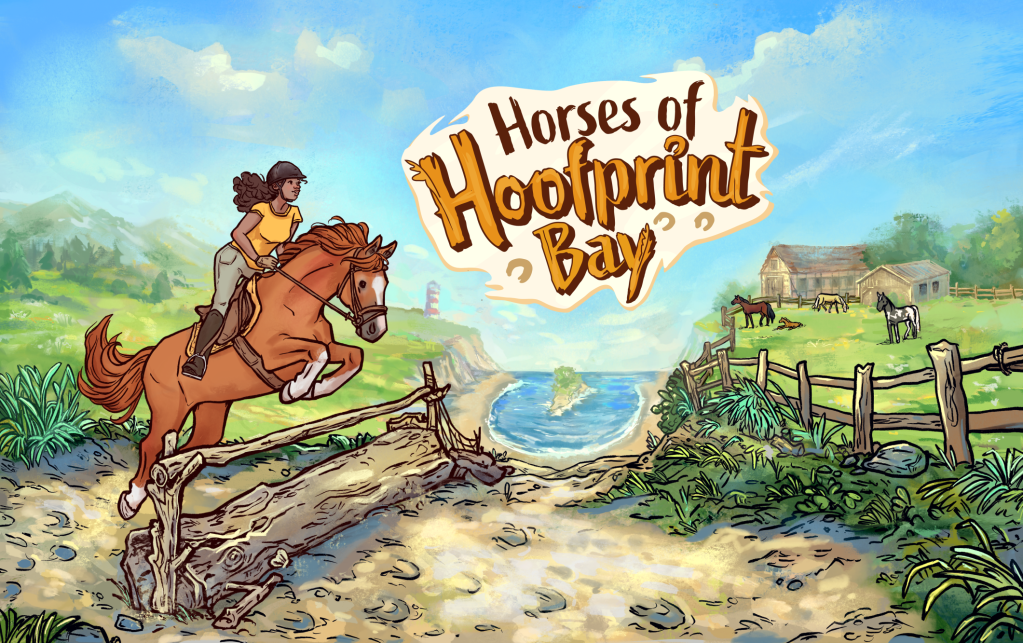
For as specialized and small as it is, the horse game niche is diverse, including titles like “Red Dead Redemption 2” where horses are a part of a wider game and the “Let’s Ride” series that places players in charge of running a stable and raising and riding horses. Titles that put horse riding and stable running in the hands of players have seen a bit of a return in the last few years with some new indie games arriving on the scene. “Horses of Hoofprint Bay” is one of those indie titles.
Most recently featured in the Summer Game Fest: Women-Led Games Showcase on June 4, 2026, “Horses of Hoofprint Bay” is a forthcoming 2D stable management and riding game taking the classic horse game setup we know and reimagining it with a modern eye. The Germany-based team behind the game consists of two individuals, software engineer Theresa Thoma and illustrator Anna Glinsmann. Known as thogli studios together and self-describing as horse girls, “Horses of Hoofprint Bay” is Thoma and Glinsmann’s first joint project.
Here, Thoma, Glinsmann and Alice Ruppert, who handles publishing and marketing of “Horses of Hoofprint Bay,” discuss some of the early development and inspiration for the game, the community response so far, and what players can expect in the final game.
Note: Interview responses have been lightly edited for clarity.
As equestrians yourself, you obviously have a great love for horses and horse games to pull from on the inspiration front for this game. But what initially brought your team together to get started on “Horses of Hoofprint Bay?”
Theresa Thoma: It was one member of the Mane Quest community that suggested Anna as the artist out of the blue after I said that I wanted to make a game like this. Anna and I both joined said Discord server because we missed horses due to our life currently not allowing for as much horsey or nature-y content as we’d liked and tried to compensate for this with horse games.
Anna Glinsmann: Yes, as soon as I saw Theresa’s very early prototype of the game she planned to make as a hobby project, I immediately wanted to join. It was exactly the type of game I’ve always wanted to make myself, but didn’t have the skills to program (I had tried several times). The nature and farm aesthetic is right up my alley, and I’ve always wanted to frame-by-frame animate all the horse gaits, as their movement is so beautiful and fascinating to me. So we got together, it turned out we had similar expectations of the project and so it worked out that over time it turned from a hobby/side project into an actual business venture!
Alice Ruppert: Essentially, the fact that I publicly (and frequently) commented on how badly my childhood favorite horse game needed a remake of some sort led to this team coming together into the right place at the right time over the course of several years.
When Anna and Theresa got together for this, I immediately clocked it as a project with a ton of potential due to the very feasible scope and obvious skill on both their parts. I reached out to them, offered my help and joined the project.
Once you started working on the game together, what did some of the early development stages look like? Was there a story, an art style, a general vibe for the game that you all wanted to pursue immediately, or did things take a little time to come together?
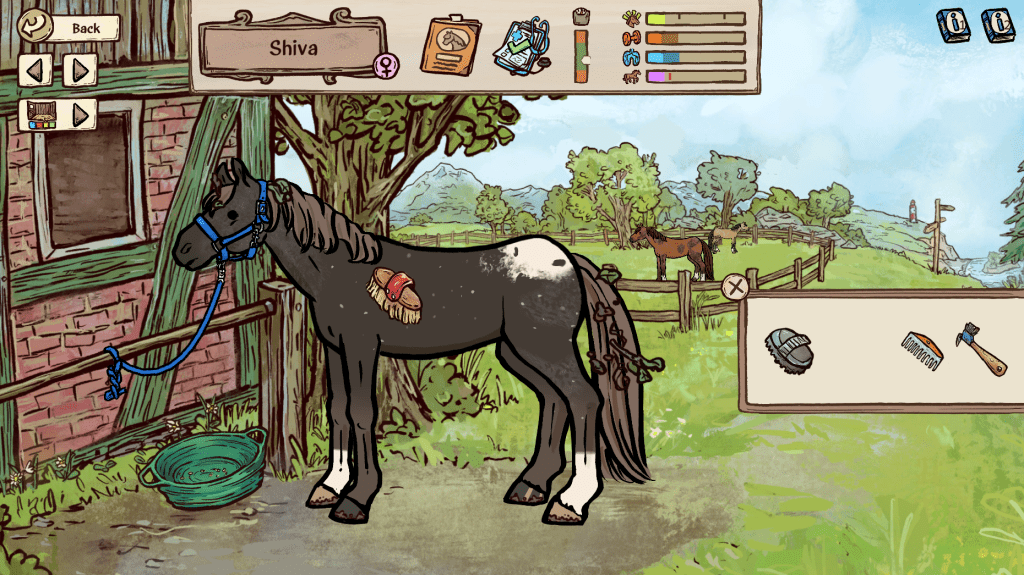
Thoma: The first thing I programmed were the very core concepts: The “main screen” is the yard overview, where you see all your buildings and horses. Then the horse care screen, where you see one horse close up. And the riding in the sidescroller.
Anna then fleshed those out with cozy, nostalgic art in her style. Her style was what drew me to work with her in the first place, so that fit my image of the game per definition. It then just evolved very naturally from there, the broad strokes mostly just fell in place. We did iterate on stuff (like the horse care screen got changed from an indoor single stable to an outdoor hitching post, because we changed that horses are kept in groups instead of single stalls, but all three of us were in favor of this change, so it was more of a “why didn’t we think of this earlier!”).
Glinsmann: Of course game development is mostly an iterative process, but I do think we never lost the initial vision of the game. We started with janky animations, quick sketches, basic UI and almost no sound, just to figure things out on a very basic level and tweak them from there. For me, the vibe and art style always felt pretty obvious as it hits so close to home for me.
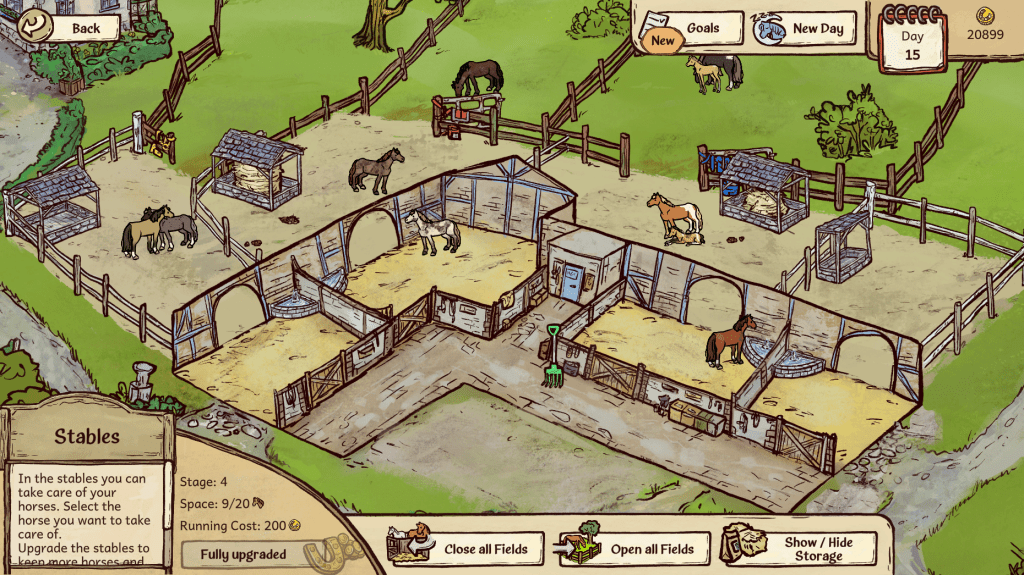
For example, for the different yard buildings and stages, I just went with the first idea I had, because I just knew what I wanted them to be like. With this setting I can draw what I know (well, except mountains) which makes adding little details easy! I also feel that as a team, we both let the other do freely what they want in their field of expertise, but also if we’re stuck or if things don’t quite feel right yet, we can discuss it together and find something that works.
So, “Horses of Hoofprint Bay” immediately has a very nostalgic vibe to it — from the stable management gameplay itself to the 2D hand-drawn art style. And it was noted in the game announcement on the Mane Quest that some inspiration for the game comes from the 2003 game “My Horse Farm!” When it came to getting started on this game, was there a hope to recapture some of the energy that horse games of the early aughts, like “My Horse Farm” had?
Thoma: Yes, definitely! Fun fact, neither Anna nor I actually played “My Horse Farm” before we started working on the game, but it was Alice’s talk about this game and why it was so good that got me to start working on this specific type of game as my new “hobby side project”. At first it was even closer to “My Horse Farm” — it then evolved more and more into its own distinct game and shape as we continued working on it.
Glinsmann: I’m definitely nostalgic for the hand drawn 2D games of that time (e.g. “Petterson & Findus,” “Willi Werkel,” or horse games like “Wendy” or “Bibi & Tina,” later on P&C adventures like “Deponia” or “Edna & Harvey”). In my childhood, I didn’t have a console and barely played 3D games apart from “The Sims,” so those watercolor style edutainment games are to me what early “Zelda” or “Pokemon” is to a lot of other devs.
Another thing that really stands out about “Horses of Hoofprint Bay” is that it is a 2D hand-drawn game! There’s almost a tactile feeling to the art from the backgrounds and horses to the little details courtesy of Anna Glinsmann’s illustrations that really bring the game to life. What inspired this approach to the game’s style?
Glinsmann: The art style is just my usual style that I developed over many years of studying the craft.
I love that you noticed the tactile feel, because that’s actually what I’m always going for! I strive for a strong sense of form, texture, and the perfect mix of colour and lines to give a sense of depth. There’s a lot of hue variation in the colour and lineweight variation in the lineart, and practically no right angle to be found. To me, that’s the small imperfections that make a scene feel human and natural. I’m going for a sort of emotional realism (rather than actual photorealism).
My style is influenced by Franco-Belgian comics, 2D illustrated point & click games, and several artists and illustrators (Uderzo, Simone Grünewald, Chris Riddell, just to name a few). A lot of people feel reminded of the “Petterson & Findus” series of children’s media, which is no coincidence as I loved those as a kid, and the setting is also not unlike the northern German countryside where I grew up.
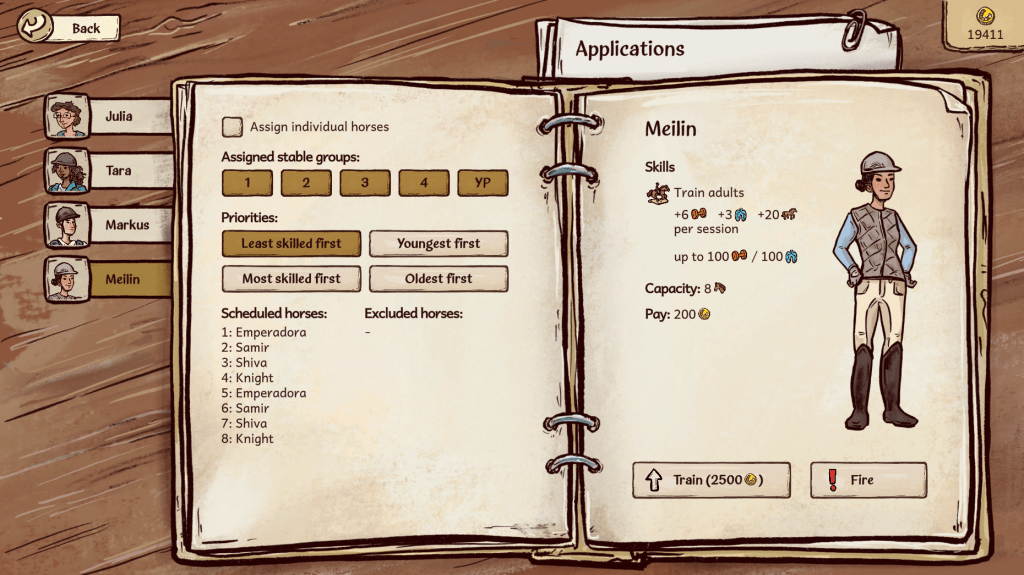
When playing, the main elements of the game include stable management and riding. What, if anything, tied into your decision to include a pretty robust selection of activities that include boarding other horses, offering training lessons, and the ability to train and compete with your own horses? Were these elements you enjoyed in other horse games or were they something you wanted to see more of in the genre?
Thoma: We needed a way for the player to earn more money, especially in the early game. Horsey things would be more fitting than a generic job like “deliver the newspapers” or “serve drinks at the local cafe”. So we started thinking “How do the (smaller) stables earn their income?” The obvious answers were “offering lessons” and “board other horses”.
I don’t know of any other game where you have to give lessons by actually correcting mistakes other riders make. So, it was exciting to think of a gameplay mechanic for that! Training your own horses and competing with them on the other hand is pretty basic “almost every horse game has it” kind of stuff.
Ruppert: The lesson mechanic is something I’ve had in the back of my mind for ages, and I’m thrilled that when I pitched it as a potential addition, Theresa immediately implemented a really cool version of it. Looking at specific aspects of equestrian life and seeing them through a game mechanical lens is something that happens a lot in my head simply because I spend so much time with these topics.
With the demo having been released in February 2026, players have now had a bit of time to play the game. What has the response been like so far? And what has it been like for you as a team to see that response?
Thoma: The response was very positive! Over 40,000 people played the demo, many different people streamed it or made let’s play videos. And we got over 850 reviews on Steam, 99% positive! As this is the debut game of our studio, we’re very happy with that. It validated that our ideas and their implementation seem to resonate with the audience. It showed us that we’re heading in a promising direction and allowed us to invest more time and money into the game than we thought would be possible in the beginning.
Ruppert: The response was so overwhelmingly enthusiastic that it got a bit much for a moment right after the demo launched! We had to quickly restructure our Discord server and add volunteer helpers to stay on top of repeat questions and player requests. The week right around the demo release was definitely quite stressful, but also super rewarding overall.
For me, since I have tried to tell people in the industry that this kind of game can be successful for years now, the positive response is also just really validating and finally confirming what I’ve been trying to prove for a while: that the horse game genre doesn’t need a “Red Dead Redemption” budget to make players really happy.
Lastly, I know that work on the game is continuing. You shared some updates on social media — including some of the drawing processes for backgrounds and the addition of new horse coat patterns. What other kinds of features or mechanics might players expect in the full game at launch?
Thoma: There’s still a huge list of ideas that we’d love to implement, but [we] have to select carefully what we can add realistically without the scope exploding and delaying our release.
Some of the ideas are going on a walk with your foals, desensitization training to raise confidence, cross country competitions, trail riding in a mountain biome, mane and tail customizations, and more technical stuff like controller support and steam achievements. If and what of those actually get implemented is not yet decided. Something we can now confirm, as I just added it to the game, are face markings for the horses! They can now look even more special with different sized stars, stripes, blazes and snips.
“Horses of Hoofprint Bay” has a demo available on Steam, and will be available at a forthcoming date.
Image Credit: thogli studios


 Video Game Town