
This guest post is written by Tiago Svn.
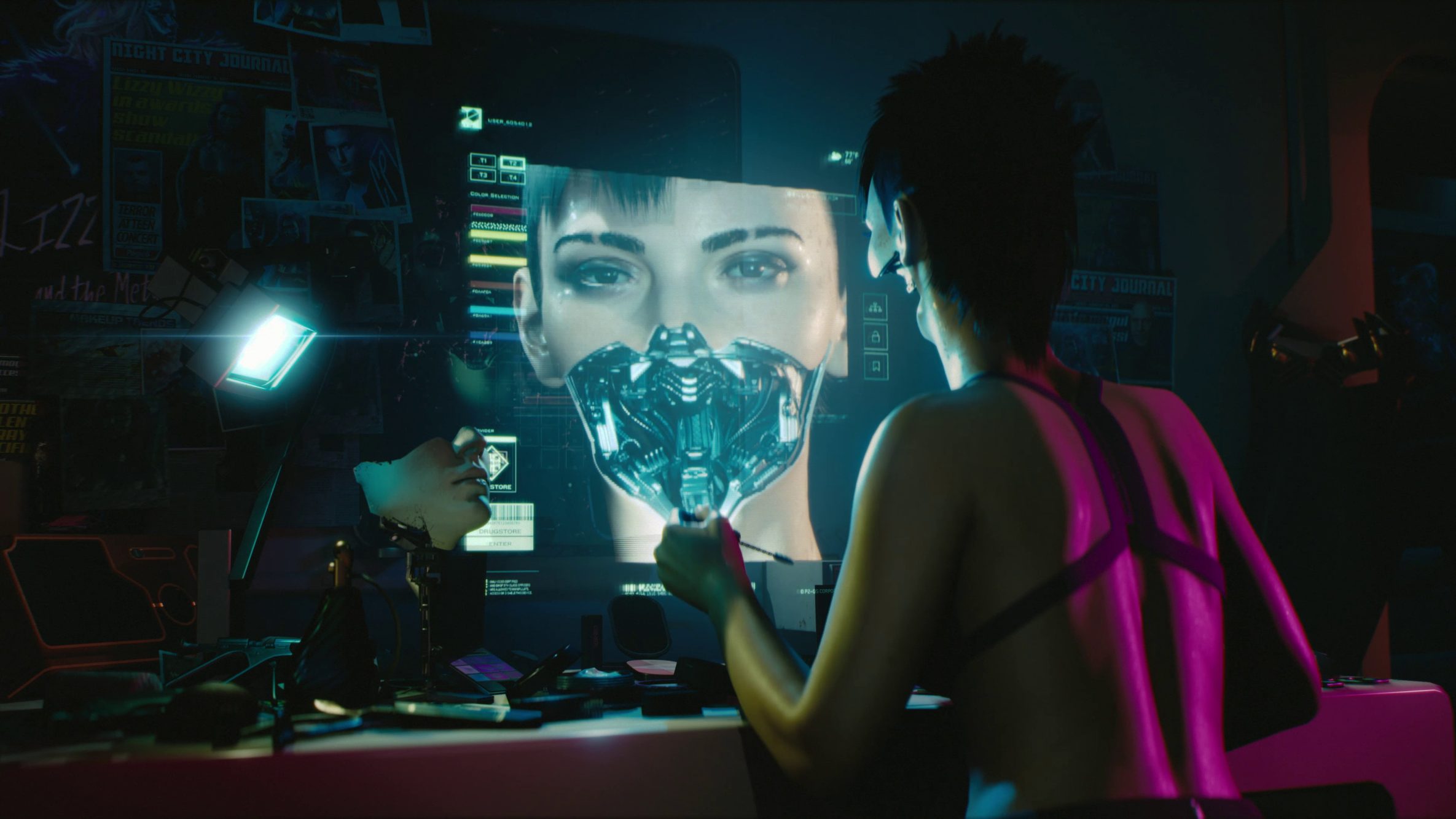
“Neuromancer” has influenced literally everything in the cyberpunk genre. “Ghost in the Shell,” “Akira,” “The Matrix,” and the aptly named “Cyberpunk 2077.”
The new trailer for the TV adaptation looks good, as in capably produced and featuring some impressive Apple-backed production values. I’m sure it’s going to be extremely OK, and thus likely a profound disappointment to anyone who cares about the genre’s intended message.
The novel opens with the famous “The sky above the port was the color of television tuned to a dead channel” line. Ironically, the harrowingly beautiful opening of the most important cyberpunk novel became its most hilariously anachronistic, as the evolution of TVs dramatically changed the “dead channel” look that we had in “1984.” For those unaware, it’s meant to look something like this beautiful artwork made by Redditor Slowface:
It’s grey, ultimately, but not simply a shade. It seems to stem from the sky glitching out and failing to understand what it’s supposed to look like. Our sky will always provide a temporary escape to the problems of the real world. Looking at “Neuromancer’s” sky, however, would likely drain more of your hope and fill you with more nausea than settling for looking at the sewage-drenched, garbage-filled streets of your average dystopian hellscape.
Nowadays, “dead channels” usually display either a totally blue or black screen, often accompanied by the words “No Signal.” It’d still be pretty scary to see that plastered over the sky, or at least scarier than the sky we see in the TV series. Still, through its grim writing, you still get the idea that this sky is meant to evoke a sense of unease or straight-up dread from one of the most relaxing things people can still witness in a capitalist hellscape for free.
The series trailer, too proudly, perhaps, also begins with a shot of the aforementioned sky, but it looks pretty normal. It’s grey, sure, but not even a grey one shade grimmer than what you get on an average day in the UK. That’s the safest and dullest way of portraying an undesirable sky, no offense to the Brits.
If unwilling to depict Gibson’s original sky, perpetually at war between the ghosts of black and white pixels for they might prove too aggressive for audiences, the people behind the series had a good alternative.
They could’ve foregone carbon-copying the aesthetic and adapting the man’s idea of an awful sky you could imagine coming to fruition in a few years, preventing both more anachronism and, better yet, looking straight-up boring. In my very sad but probably prescient nightmares, that sky would look completely lined with ads for all sorts of broken AI products hallucinated by AI companies joyfully freed from our silly desire to appeal to the human eye.
And that’s just what’s wrong with the first shot, but the rest of what’s seen follows suit. Everyone is naturally beautiful, and yeah, I didn’t expect anything else. Still, everyone seems like they just came out of the best shower of their lives, a very strange look for the main character, Case, a down-on-his-luck drug addict ex-hacker. And it’s not just the skin; everyone’s clothes seem to be in a permanently pristine state as well. There’s no dirt or smoke on the street, an element that famously gave the original “Blade Runner” some of its most memorable shots, and at a very low cost.
“Neuromancer” begins in “Night City”, the shadiest and most dangerous district of the made-up city of Chiba in Japan. Strangely, what we see is so clean and sterile you couldn’t tell it from a set if you didn’t already know it was one. If that neat place is hell, then I really am not equipped to even begin imagining what paradise must look like there.
And this sucks, because the right cyberpunk aesthetic has been achieved a few times in the past, and for a lot less money. Just look at 1990’s “Hardware,” a cheap movie that somehow creates such an immersive and twisted cyberpunk dystopia that you almost forget that the main character wears something heavily reminiscent of a Nintendo Power Glove for a hand whenever he’s on screen.
It takes place in one of the most inhospitable sci-fi hellscapes I’ve ever seen, one where people who leave their homes have to deal with radioactive garbage most of the time, and, when they’re lucky, with just plain regular garbage. Though it’s never stated, it’s pretty evident that nobody from our world and time would survive there for long. The world of “Hardware” rocks because it looks plainly impossible to survive, not just challenging but in a way that you could totally overcome with a bunch of cool tech augments.
Another, this time way more famous movie whose aesthetics could’ve inspired the looks of the “Neuromancer” TV series, John Carpenter’s “Escape From New York,” and we know this because Gibson himself has stated that its world, albeit non-cyberpunk, served as a massive inspiration for his novel.
And I’m aware that most of what I’m asking of the “Neuromancer” show could cause most viewers to stop watching the show after a short while, but that’s a good reason why “Neuromancer” didn’t leave the realm of written words for so long. The nightmares within should project into the minds of those who dare venture in, become one’s own, and frighten readers to the point of inspiring them to prevent it from coming to fruition in the real world, not to make casual viewers wonder if they could not only survive, but thrive in there.
Cyberpunk isn’t meant to be fun, or at least not before scaring the hell out of you. William Gibson himself expressed a similar sentiment when he saw the first glimpses of “Cyberpunk 2077,” a game that originally looked as philosophical and politically challenging as GTA with futuristic mods, then turned out to be that but with the addition of a myriad of wild glitches.
When first seeing “Blade Runner,” author William Gibson decided to flee the theater because the film’s world looked way too much like what he had envisioned for “Neuromancer.” Near-constant rain, perpetual night only partially lit up by cool neon signs as a constant reminder that capitalism remains — and it’s not even capitalism of the “good” American kind. No one attempting to create the next great Cyberpunk story will have to close the YouTube tab where the Neuromancer trailer is playing because it looks too inspirational, even if it shows a much more palatable dystopia than most others.
And haven’t cyberpunk gadgets become anachronistic too?
And the problems don’t all stem from poor aesthetic choices. They took too long to make Neuromancer, and they’re releasing at the worst possible time (so far) tech-wise, as all the cool tech augments and devices strike me as yet another point of unfortunate irony. We’re already living in a time when we barely own anything, and every piece of tech is over-expensive and engineered to crash and burn early, and is only now starting to be filled with AI functionalities that make it work like crap. Can we even imagine a future where we’ll find anything useful, let alone find any sort of cybernetic apparatus usable against an evil mega corp or regime?
Legendary Aphex Twin collaborator and cinematic visionary Chris Cunningham was once poised to helm a “Neuromancer” adaptation, but that project ended up canned for unknown reasons. Maybe because Cunningham had no experience directing actors in such a mega production, but I’d like to believe it’s because he would’ve intentionally made it harrowing to the point that most viewers would’ve tried to jack out of their own base reality.
You know “Blade Runner” as an indisputable classic nowadays, but it bombed upon release. That might’ve cursed audiences into never getting any similarly dour aesthetic out of a movie, series or game world meant for a large audience, likely because the visuals are the easiest thing to blame for alienating people— hence this piece— but they might do an even worse job of convincing people to stay glued to a screen if the execs go for the most generic art direction they can muster.
Honest cyberpunk must challenge you. You cannot hope to create a work that’ll have people truly question the nature of the world they inhabit, without giving them time to, well, question it. Unfortunately, however, anything slower than an immediate overwhelmingly positive reaction from millions of people is too little, too late.
The contradiction of a great cyberpunk landscape is that you’d never want to inhabit it. Perhaps spy on it for two hours, but definitely not stay there for the 10-hour duration of a series. At best, you’d like to visit for a second, but only because you got drawn in by all the bright neon lights, or, well, because you want to visit the world of a cool show, like you would an even more perverted version of Disney World.
Five seconds in, though, it should make it abundantly clear that you absolutely don’t have what it takes to make it there. And that’s fine. It’s not about surviving it, but about never letting your world get to that point. By “yassifying” cyberpunk like “2077” did, or standardizing it like the “Neuromancer” series seems to be attempting, we’re actually just normalizing the apocalypse.
Image Credit: “Cyberpunk 2077”


Leave a Reply