
This guest post is written by Eric Vanderwall.
It’s night, late in a wedding reception, near the end of festivities. The band Bride and Groove is playing Kool and the Gang’s “Celebration,” an obvious standard for such occasions with its lyrics (“There’s a party goin’ on right here / A celebration to last throughout the years”) and readily danceable four-four meter and moderately vigorous tempo. Guitarist and lead singer Rick Power, judging it to be an appreciative crowd, introduces one of his original songs, and as he leads the band in performing it, enters a reverie in which the brightly lit little event hall transforms into a vast stadium, of fans waving phones.
But songs and dreams end, and when Rick’s do, the dance floor is nearly empty. No matter how good his own songs may be, this audience, like most audiences, doesn’t want to hear anything new and unfamiliar; they want to hear the hits they’ve heard many, many, many times before. Gigs, too, come to an end, and drummer/bandleader Binzer (Rory Keenan) rebukes Rick for playing originals when that’s not what they were hired to do.
This is the viewer’s introduction to Rick Power (Paul Rudd), one of the principal characters in director John Carney’s new film “Power Ballad.” The film apparently takes its name not from the term for the genre popular in the 80s and 90s and exemplified by works such as “Every Rose Has Its Thorn,” Faithfully,” and “Keep on Lovin’ You,” but from the character Rick Power. The film is thus not a ballad characterized by power but a ballad — in the somewhat older sense of a tale — about Power.
Rick is an American musician living in Dublin with his Irish wife Rachel and teen daughter Aja (perhaps named for the Steely Dan song and album). He originally came to Ireland about twenty years earlier with his own band, and stayed because he met Rachel and soon had Aja. (Whether this began as a one-night stand that resulted in pregnancy or a more considered relationship is a question briefly implied but otherwise ignored.) Rick continues to write his own songs, though now his wife and daughter are his only audience, and a reluctant audience at that (as seen when Aja tries to walk silently past her dad’s home studio to avoid having to listen to his latest demo).
When Bride and Groove perform for an extravagant wedding at a castle, former boy band star Danny Wilson (Nick Jonas) attends as a guest and joins the band onstage to sing Stevie Wonder’s “I Wish” as with Rick. While the song’s mourning of lost youth (“I wish those days would come back once more / Why did those days ever have to go?”) develops and expresses Rick’s own implied feelings and helps set up the contrast (and later conflict) between Rick and Danny, it is comic (perhaps unintentionally so) to hear Nick Jonas sing the verse’s opening line about looking back on being “a nappy-headed boy.”
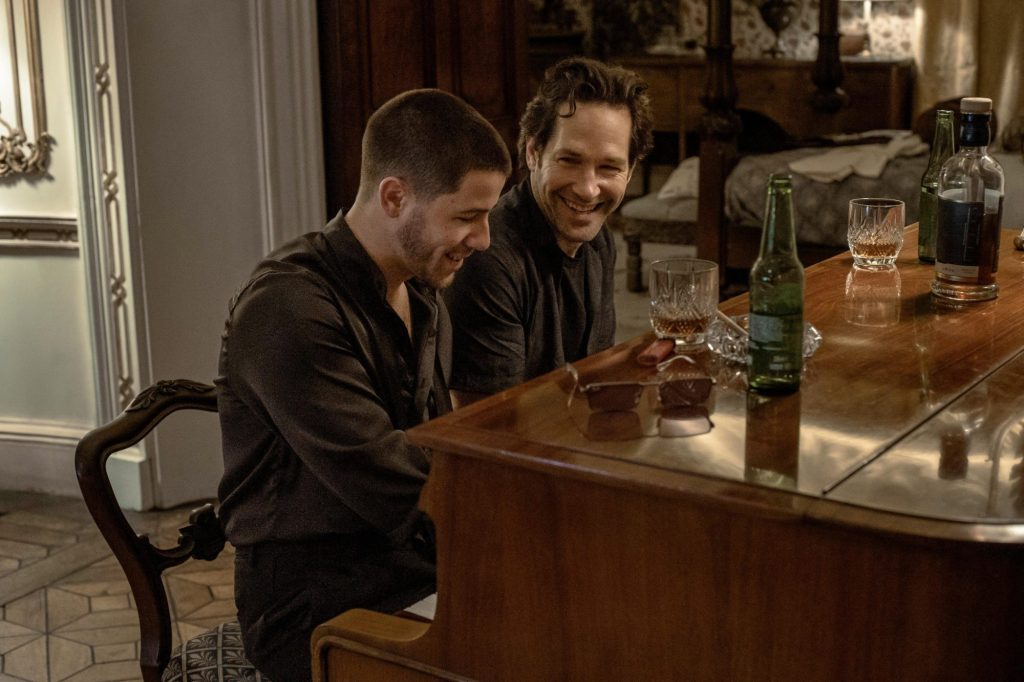
Later, when Rick is walking the castle grounds, Danny invites him to his room to continue playing music. The men start by improvising style parodies of boy band music and, having developed a mutual respect, reveal some of their feelings (Danny’s anxiety about writing material for his first solo album, Rick’s sacrifice of his career as a performer of original music) and play parts of songs they have been working on. This scene handles the contrasting roles of gigging local musician and pop star well, undermining the typical film portrayal of wedding-musician-as-hack by having Rick give Danny some songwriting tips and present some songs that impress Danny, especially the unfinished “How to Write a Song (Without You),” which Danny suggests they finish together though Rick demurs that it’s late and time for him to go.
Where Rick appears in scenes of camaraderie and family, Danny is largely alone: Alone in the airport, driving his convertible alone, returning alone to his large luxury home, recording demos in his home studio alone. Even his girlfriend Marcia seems at a distance, both literally (apparently occupying the far end of the large house) and in other respects (as a listener when Danny talks about his career but never, apparently, being of interest to him except as an audience). Danny struggles to write a song to impress his agent Mac (Jack Reynor), who warns of a possible future in which Danny is making appearances as the guy who used to be in that boy band and “eating bugs on a reality show.”
Six months later, Rick is buying shoes at a store in a shopping mall when he hears something familiar playing in the background, which turns out to be Danny’s polished pop production of “How to Write a Song (Without You).” Here the film introduces one of the paradoxes in music, which is that sometimes its debasement increases its perceived value; when Rick plays his original songs at a wedding gig or at home, people are averse or at best indifferent, but when the same song is processed into a slick bit of aural content, it is simultaneously both inoffensive sonic filler (in settings such as the mall) and a highly profitable commodity (for streaming and download and, as we see later, major concerts).
Rick continues to insist to his family and friends that he wrote the song, none of whom recall having heard it. His increasingly erratic and irascible behavior at gigs — set in part to the refrain of The Police’s “Message in a Bottle” (“Sending out an SOS / Sending out an SOS, etc”), another of the film’s apt pairings of narrative with music—culminates in an outburst after a bride requests the band perform “How to Write a Song” and another outburst when his daughter and wife sing along to “How to Write a Song” on the radio, each a development of the paradox of perceived value.
Rick has spent much of his life trying unsuccessfully to get people to listen to his original songs, but once one of those songs comes to people with the trappings of corporate pop, as a commodity produced by a faraway pop star and not the earnest work of a suburban dad and working class musician, then the same song becomes widely beloved. Inherent value and perceived value are not always equivalent.
Rick is ejected from the band and family home and, with nowhere else to go, goes to Bride and Groove’s lead guitarist Sandy (Peter McDonald), also fired from the band for taking Rick’s part in an onstage scuffle. The two then go to Los Angeles to confront Danny, first attending one of his packed arena shows (a clear contrast to Rick’s position as gigging musician and unappreciated songwriter, and thus another dramatization of the paradox of perceived value) and eventually finagling their way into an after-party at Danny’s house, where Rick confronts his erstwhile songwriting partner in a hot tub.
That Rick, seeming mildly deranged, climbs into the hot tub while still clothed, makes it a humorous moment but also a variation on their first encounter, when they spent a night together in Danny’s guest room. The homoeroticism in these moments is apt, implicitly conveying that the tension between Danny and Rick is not just about future royalties or public recognition; the bond between these two men, as between any people who hit on something special when playing music together, is deep and intense, verging on the sexual.
Their confrontation ultimately escalates into comic violence (in which Sandy bludgeons Danny’s security staff with the Gibson), from which Rick and Sandy escape battered but without any more chance of Rick getting a songwriting credit or a portion of earnings than before.
And then the film subverts its own moral lesson. Aja is looking through old photos and videos on her dad’s computer when she finds one with Rick at the piano, playing “How to Write a Song.” In the film’s final scene, Rick throws a thick bankroll into a busker’s guitar case, implying that, with the recently rediscovered video, he has been able to establish his songwriting credit and claim his rightful portion of the earnings.
Such an ending allows the audience the treacly gratification of the good guy winning out, releasing them from the vicarious pain of Rick’s position — being, as Rachel describes it, “robbed.” It’s an ending that tries to have it both ways, proffering a moral lesson and then removing the hardship that made the moral lesson necessary. If “Power Ballad” were a song, this would be the variation in the last chorus or the coda that diminishes all that came before.
What we have in “Power Ballad” is a good movie, but not a great one. It is more musically literate than the average movie, both in how its characters talk about and make music and in its attention to how to match music to action.
The film also succeeds in depicting both Rick and Danny with some nuance: Rick as both an underappreciated songwriter and as lacking in the follow-through necessary to be a great songwriter, whereas Danny has that discipline but less intuitive aptitude and less emotional depth to draw on in his writing (and, of course, less integrity). “Power Ballad,” in the end, resembles many a pop song: decent but slightly less than satisfying, somehow taking serious subjects and turning them cloyingly sweet.
Image Credit: “Power Ballad”

 Video Game Town