
This guest post is written by Josh Bell.
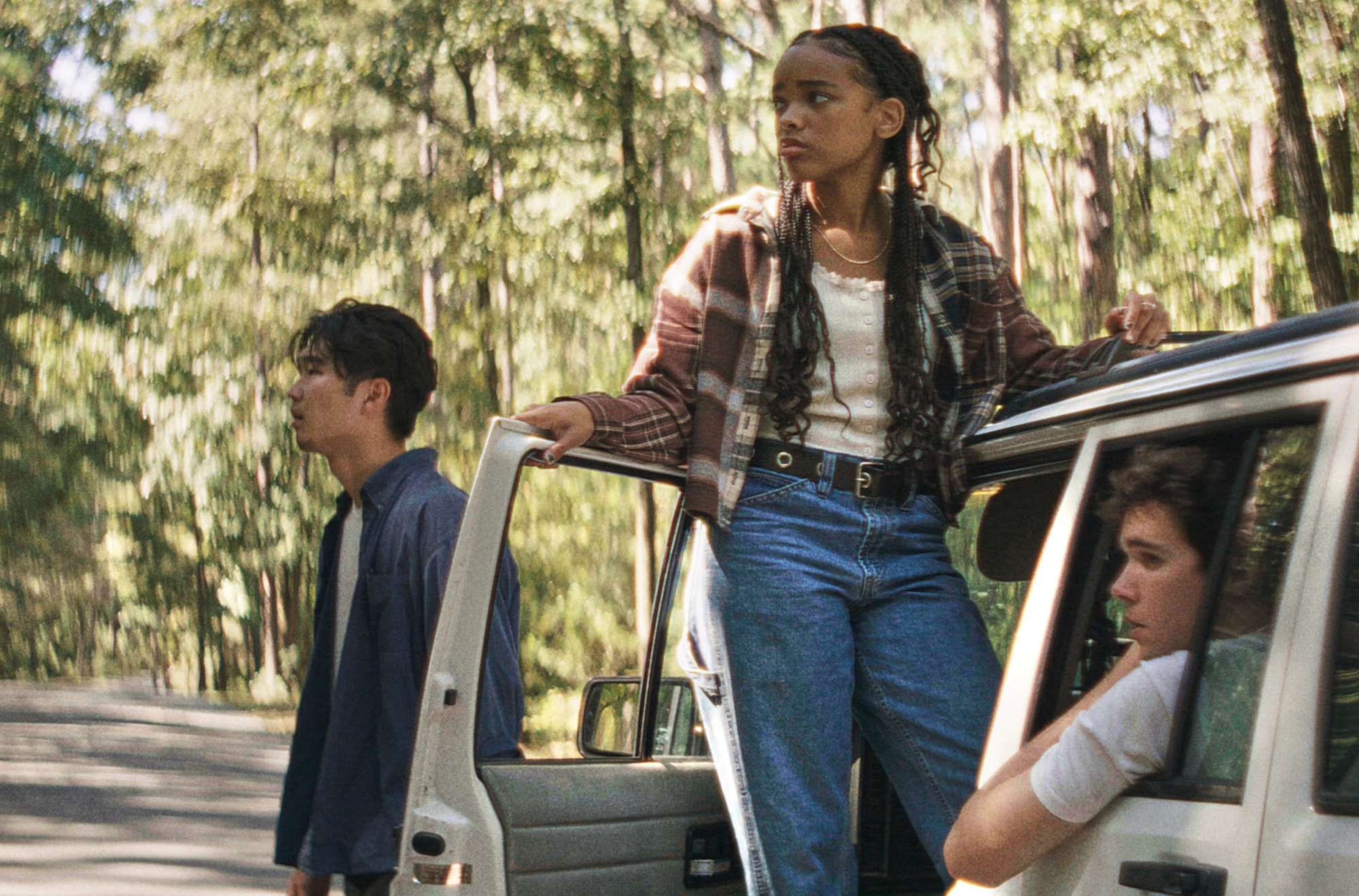
Early in “It Ends,” before the four main characters realize that they’ve become trapped on a seemingly endless road, James (Phinehas Yoon) offers a stark assessment of his future prospects, describing a miserable-sounding but outwardly successful life that he expects based on his recently received engineering degree. “I’m still trying to get my shit figured out,” his friend Day (Akira Jackson) has already told the group, and while those seem like opposite perspectives at first, they’re really just two sides of the same bleak worldview that writer-director Alex Ullom lays out for his generation of young people.
If “It Ends” were just an extended metaphor for the hopelessness facing current college graduates, it wouldn’t be much of a movie, but Ullom builds a sense of existential dread and terror that goes beyond allegory. Viewers of any age can appreciate the movie as a representation of the constant stream of terrible news that hits anyone who goes online these days, but “It Ends” also works as a sustained freakout over being transported to an actual, non-metaphorical realm of mysterious, unending torture.
It’s also a pretty good hangout movie, with strong performances from the central quartet. James, Day and Fisher (Noah Toth) are all moving out of their college housing, preparing for the next phases of their lives, while fellow high school friend Tyler (Mitchell Cole) has taken a different path, serving in the military before finding work as an HVAC technician. Tyler helpfully offers them a ride, and there’s a mix of camaraderie and tension as they reunite with someone they used to be close with but haven’t seen in a while.
There’s some tension among James, Day and Fisher as well, although they also have the relaxed chemistry of people who’ve known each other since childhood. What seems like a brief catch-up session before they’re all dropped off at their respective destinations turns into a nightmarish odyssey when Tyler follows their GPS directions down a lonely forest road. It’s a striking contrast from the busy highway they were just driving on, but no one notices anything amiss at first. Believing that they must have missed the turn-off that was supposedly coming up shortly, Tyler decides to circle back, only to discover that the way they came has now been entirely blocked off by more trees.
At that point, the characters finally realize what would be immediately apparent to anyone who’s seen a horror movie: This is no ordinary road, and there’s no way to get away from it. Ullom carefully puts the terrifying pieces in place, and imminent danger arises as the characters search outside the car for clues about their situation. Illuminated only by the car’s flashing red lights in the darkness, hordes of frenzied people suddenly emerge from the forest, screaming and clawing at the four friends. Fisher is even injured before they can climb back in the car and drive away.
The inexplicable attacks are scary, but what’s scarier is that there’s no escape on the horizon. James is the most methodical, and he treats their predicament like a puzzle, a familiar tactic from cult horror movies like “Cube” or “Circle,” in which people are suddenly dropped into strange traps and must figure out the rules in order to get out. Ullom’s influences are more philosophical, though, and “It Ends” is closer to Jean-Paul Sartre’s existentialist classic “No Exit,” or the “Twilight Zone” episode “Five Characters in Search of an Exit.” Still, there’s enough logic amid the surrealist abstraction for the characters to eventually establish some guidelines.
Rather than simply losing their heads — although there are plenty of panicked moments — the friends devise tests to determine the parameters of their environment, and Ullom ensures that “It Ends” isn’t one of those horror movies in which the audience is going to yell at the characters for making stupid decisions. At the same time, there’s a sense of futility to all of their efforts, which land them no closer to actually getting away from the never-ending stretch of road.
They no longer feel any bodily needs (hunger, thirst, sleepiness, sexual desire), and the car never breaks down or runs out of gas, no matter how long they keep driving. That open stretch of nothingness is as terrifying as the crazed people whose presence eventually becomes routine. “It Ends” is split roughly into two halves, with the first half as a more traditional horror movie, focused on avoiding immediate physical danger, and the second half (introduced with a title card that simply reads “Way Later”) as a psychological drama about coping with a potentially eternal emptiness.
Both halves succeed in their respective aims, but Ullom has trouble bringing the whole thing together at the end. Viewers looking for concrete answers may be frustrated, but that’s exactly how the characters feel, and it’s exactly how people their age feel in real life. In a world in which true certainty seems further and further out of reach, there isn’t much difference between driving down a road that never ends and embarking on a career or life path that is likely to lead nowhere.
That doesn’t mean it’s not possible to find some companionship along the way, and despite the issues they have with each other, the four friends offer more solidarity than bitterness, in contrast to their sour counterparts in Sartre’s landmark play. The actors create distinctive, well-rounded characters within the limited setting, so that their conflicts have specific emotional stakes rather than just symbolic meaning.
Ultimately, that’s what makes “It Ends” such an effective, gripping movie. It’s easy to imagine your own response to such a dilemma, but it’s also fascinating to watch how these particular people respond. There’s quiet devastation in the way that Day keeps listening to a mundane voicemail from her mother, or Fisher pleads for the possibility of retreating into unconsciousness.
In his initial analysis, James wonders if they’ve died and gone to hell, and if so, what they’ve done to deserve such punishment. The unsettling answer is that they haven’t done anything, just as their real-life generational counterparts haven’t done anything to deserve the chaotic, hostile world they’re inheriting.
Image Credit: “It Ends”
Leave a Reply