
This guest post is written by Josh Bell.
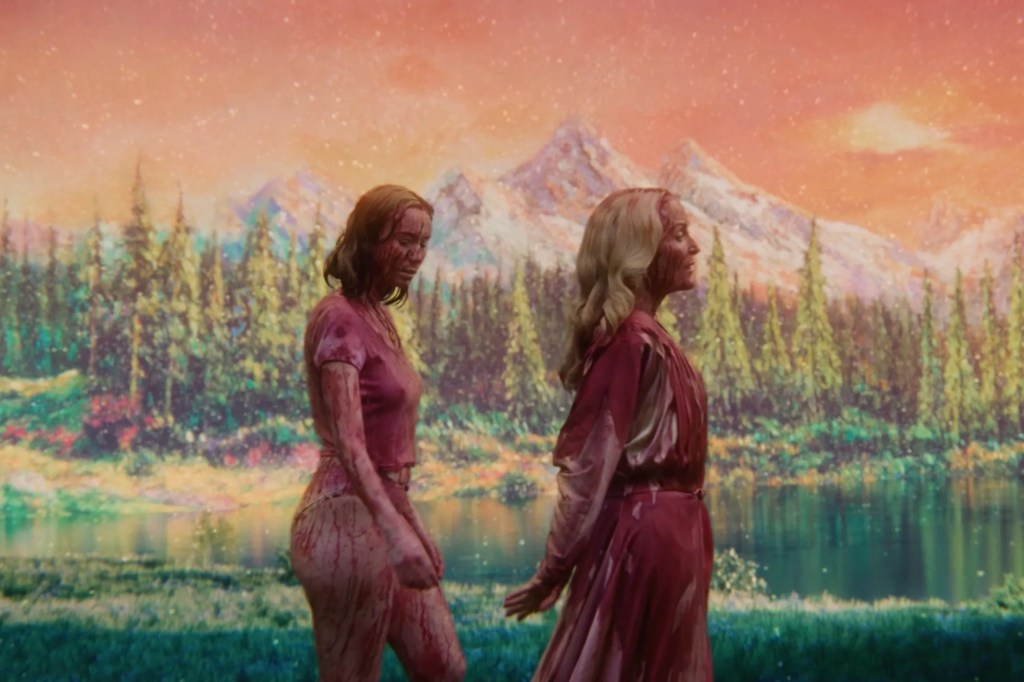
After filmmaker Kris Williams (Hannah Einbinder) lays out her lengthy intellectual take on the themes of the “Camp Miasma” slasher franchise to the original movie’s star Billy Presley (Gillian Anderson), Billy stops and corrects her, asserting that “Camp Miasma” is really only about two things: “Flesh and fluids.” That may not be a perspective shared by “Teenage Sex and Death at Camp Miasma” writer-director Jane Schoenbrun, who doesn’t exactly skimp on the flesh and fluids, but leans more toward Kris’s post-modern deconstructionist take on the slasher subgenre.
That lines up with Schoenbrun’s previous two films, each of which offers an imaginative but often obtuse vision of a particular subset of genre entertainment. Schoenbrun appears to be moving back in time through pop culture, taking on internet creepypastas in 2021’s “We’re All Going to the World’s Fair,” 1990s teen sci-fi TV in 2024’s “I Saw the TV Glow,” and now 1980s slasher movies in “Teenage Sex and Death at Camp Miasma.” In each case, Schoenbrun’s fictional piece of cultural ephemera becomes embedded in the personal life of the movie’s protagonist, in a way that seems deeply meaningful to Schoenbrun but is often hard to parse for anyone outside the filmmaker’s head.
It’s not necessary to understand everything about an artist’s intentions in order to appreciate their creation, of course, and Schoenbrun has plenty of devoted fans, who may someday make their own meta interpretations of the cult filmmaker’s work. Those fans have already fallen for “Teenage Sex and Death at Camp Miasma,” which is certainly Schoenbrun’s most polished film to date, not least because of its more substantial budget and access to accomplished stars Einbinder and Anderson.
The burgeoning relationship between Kris and Billy is by far strongest aspect of the movie, which could have been a tender and affecting romance without any of the confusing self-reflexive elements. Kris is a longtime fan of the “Camp Miasma” franchise, which began sometime in the 1980s and has devolved into straight-to-video garbage, as detailed in an ingenious, meticulously crafted montage of clippings and memorabilia over the opening credits. Following the minor critical success of her low-budget first feature, Kris has been hired to reboot “Camp Miasma,” and her first priority is to track down Billy, who played the enduring final girl in the original “Camp Miasma.”
Since then, Billy has quit acting and become a recluse, refusing to appear in any of the sequels and currently living in the actual remote sleepaway camp where the first “Camp Miasma” was filmed. The references are obvious, and Schoenbrun doesn’t pretend that they aren’t: Pretty much any movie that cinephiles can think of as a touchpoint for “Teenage Sex and Death at Camp Miasma” will soon be cited by the characters themselves, from “Sunset Boulevard” to “Psycho” to “Wes Craven’s New Nightmare,” plus all of the slasher classics that have been mashed together into “Camp Miasma,” most notably “Friday the 13th” and “Sleepaway Camp.”
When Kris arrives at Billy’s isolated hideaway, their initial conversations are a bit stiff, as Kris delivers her practiced sales pitch for Billy to return to the “Camp Miasma” franchise, while the eccentric Billy pushes for a more intimate connection. Einbinder and Anderson have appealingly spiky and spicy chemistry from the start, and Schoenbrun is smart about depicting the generation gap in sexual values without denigrating either of their points of view. Kris is in a polyamorous relationship with Mari (Jasmin Savoy Brown), but she doesn’t sound very enthused about it, and Billy has her own complicated sexual history tied in with her experience shooting “Camp Miasma.”
The way they come together, bonding over horror movies, candy, and a surprisingly sensual mutual appreciation of fried chicken dipping sauce, is sexy and sweet, and “Teenage Sex and Death at Camp Miasma” could be a story about two showbiz outsiders forging a connection in the face of an industry that devalues and denigrates them. That’s only a small part of the movie, though, and an awkward, unfunny scene in which Kris pitches her new, unhinged ideas for the “Camp Miasma” reboot to a bunch of smarmy studio executives on a Zoom call is easily the nadir of Schoenbrun’s scattershot approach. The usually funny Sarah Sherman is mostly just annoying as Kris’ clueless agent.
Instead, Schoenbrun embraces the surreal uncertainty they’ve become known for, blurring the lines between Kris and Billy’s interactions and the events of the “Camp Miasma” movies themselves. While “I Saw the TV Glow” featured select moments from the fictional 1990s TV series “The Pink Opaque,” “Teenage Sex and Death at Camp Miasma” devotes substantially more time to large chunks of the movie within the movie. As in “I Saw the TV Glow,” Schoenbrun doesn’t exactly aim for a straightforward pastiche of the genre they’re recreating.
No one would mistake the scenes from “Camp Miasma” for actual clips from a 1980s slasher movie, and the franchise’s killer, a genderfluid teen who inexplicably wears an air-conditioning vent on his head, looks nothing like any iconic — or obscure — slasher villain. As played by Jack Haven of “I Saw the TV Glow,” the spear-wielding Little Death is more of an abstraction than a character, and even his name is just a play on words, a reference to the French slang term (“la petite mort”) for an orgasm.
Despite Schoenbrun’s obvious love for slasher movies, the “Camp Miasma” scenes are among the least effective, especially a drawn-out sequence inexplicably (and anachronistically) set to the Counting Crows’ 1996 hit “A Long December,” in which Little Death’s murder spree is depicted with garish modern CGI that looks nothing like vintage special effects. As in “I Saw the TV Glow,” Schoenbrun pays homage to a very specific type of entertainment apparently without understanding some of its fundamental building blocks, and that just makes the “Camp Miasma” excerpts feel interminable.
“Teenage Sex and Death at Camp Miasma” doesn’t need to be a slavish tribute akin to something like the low-budget slasher recreation “The Third Saturday in October: Part V,” but if Schoenbrun has something substantial to say about the subgenre’s themes and sociopolitical subtext, it gets lost in the, well, miasma of cryptic imagery and elliptical dialogue. When Kris and Billy lie together, baring their feelings along with their bodies, the movie has a quiet sensitivity and yearning. The rest is just intellectualized wankery.
Image Credit: “Teenage Sex and Death at Camp Miasma”

 Video Game Town
Leave a Reply