
This guest post is written by Jack Thomas Lawson.
Nick Offerman won an Emmy for forty-five minutes of television that has almost nothing to do with the main plot of “The Last of Us.”
“Long, Long Time,” the third episode of HBO’s adaptation, spends nearly its entire runtime on Bill, a paranoid survivalist, and Frank, the man who wanders into his fortified town and stays for 20 years. Steven Spielberg wrote the production team a letter about it. It sent a 50 year-old Linda Ronstadt song back up the charts.
Critics who cover prestige drama for a living called it one of the best hours of television in years, full stop, no video-game qualifier attached. It also, depending on who you ask online, either “ruined the show” by wandering away from Joel and Ellie for an entire episode, or is the single best hour of television to come out of a video game. The kind of episode people who’ve never touched a controller bring up unprompted at dinner parties, the way people bring up the Red Wedding.
Here’s the part that tends to get lost in the discourse: none of it was required.
In the 2013 game, Bill and Frank’s relationship is barely there. Players meet a hardened, solo Bill, already alone, already closed off, with no explanation offered up front. Later, in a stretch of the game most people speed through on their way to the next set piece, players find Frank’s body hanging from a rafter and, if they bother to look, an optional note nearby.
Bitter and unresolved, that’s the only real evidence a relationship existed at all. No cutscene walks a player through twenty years of history. No mission marker flags it as important. No score swells to tell anyone this matters. It’s a corpse and a piece of paper a player can absolutely miss entirely, sitting inside a game about brutal survival, not romance, in a section of the map that exists mostly to be crossed rather than lingered in.
HBO took that scrap (genuinely a scrap) by game standards, three sentences of bitterness scrawled on a torn page and built the emotional center of an entire season around it. Where the game gestures, the show sits still. It slows down for two decades it didn’t have to earn, because the game already did the earning, quietly, in a room most players never entered.
That’s the trick worth naming prestige TV’s biggest gritty adaptations keep getting their best material from the parts of the game nobody was required to engage with. Not the plot. The environmental debris around the plot. The stuff a strategy guide files under optional and most players never bother to read, because reading it means standing still while something else could be trying to kill you.
Games have always treated this material as flavor, not substance. It’s why finding a specific note in “Bioshock” or reading the wrong journal in “Dark Souls” feels like trespassing.
Like discovering something the game didn’t expect you to find, because statistically, you weren’t supposed to. Item descriptions in “Dark Souls” famously carry entire tragic backstories in two sentences of flavor text attached to a sword nobody equips. That kind of writing gets made for an audience that might not show up. It’s written with the assumption of being skipped. Which is a strange thing to ask a writer to do well, and a stranger thing to then get no credit for doing well. It rarely gets credited for it, because the credit-giving apparatus (reviews, awards, water-cooler conversation) is built around what a game requires you to see, not what it merely allows.
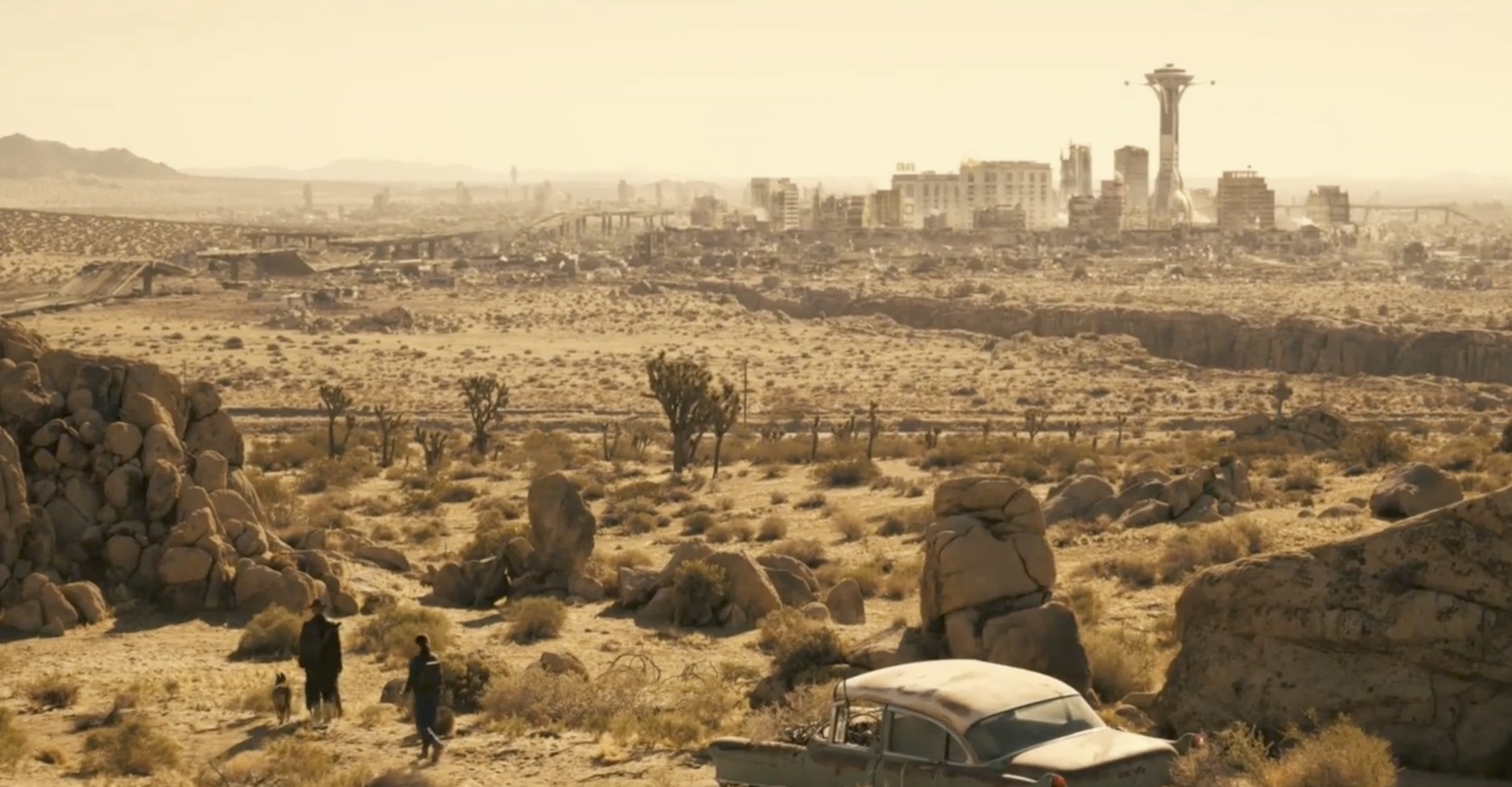
“Fallout” runs the same trick, just louder, and with more real estate to work with. Cooper Howard’s slow rot into The Ghoul is the emotional spine of the show’s first season, told in patient flashback across the whole run rather than crammed into a single episode. In the games, that kind of backstory almost never arrives as a cutscene.
It’s a terminal entry left running in a dead bunker, a holotape in a desk drawer next to a skeleton still holding a coffee mug, texture a player can walk straight past on the way to a quest marker. Nobody is stopped and told: this matters, sit with this. Lore exists for the type of player who reads everything, and that player has always been a minority. The Vault-Tec dinner party sequence works the same way: funny, then quietly horrifying, then funny again, which is exactly the rhythm of stumbling on a two-hundred-year-old advertisement still looping on a cracked monitor in a building nobody’s opened since the bombs fell.
The show didn’t invent that tone. It found it lying around in an environmental storytelling tradition “Fallout’s” been running since 1997 (vaults as morality plays, pre-war ads as dramatic irony) and had the good sense not to mess with it, just point a camera at it and let it play out at full length.
“Arcane” does it too, at a different scale and from a different kind of source. Vi and Jinx’s fractured-family arc (the emotional backbone of the whole show) is built from material that, in “League of Legends,” mostly exists as lore blurbs on a website most players have never visited, character bios written for people who care more about a champion’s backstory than anyone actually needs to in order to play the game well. The game treats it as backstory, easily skippable, entirely irrelevant to whether someone wins a match. The show treats it as the whole point, the thing the entire season is organized around.
“Cyberpunk 2077” and its anime tie-in “Edgerunners” tell a version of the same story from the opposite direction. The game buries a staggering amount of Night City’s history in shards – text fragments scattered through the world, most of them optional, many of them never opened by most players, because there’s a mainline story and a hundred hours of side content competing for the same attention.
“Edgerunners” isn’t even adapting a specific plotline from the game; it’s adapting a mood and a set of implications the shard-writers spent years building out in the margins. The exploitation of edgerunners by corporations, the specific tragedy of chrome addiction, the texture of a world that treats human bodies as upgradeable hardware. None of that required reading to finish “Cyberpunk.” All of it is why “Edgerunners” landed as hard as it did, hard enough to send the game’s player numbers and sales climbing again a full year after a famously rocky launch. Proof that the “optional” material wasn’t a footnote to the main story. For a lot of viewers, it turned out to be the more compelling story.
None of this is a knock on the writers’ rooms. Quite the opposite. These are teams that clearly played the source material closely enough to notice what the games themselves undersold, that went looking in the drawers instead of taking the tour. The best character work in “The Last of Us,” in “Fallout,” in “Arcane,” in “Cyberpunk 2077,” was rarely sitting in the main quest line. It was sitting in a drawer, on a corpse, in a terminal nobody was told to check, in a shard nobody was told to open, waiting for someone patient enough to stop and read it instead of moving on to the next objective marker.
Which is what should sting a little on the games side of this. If the best writing was optional the whole time (unscored, unmarked, skippable by design, competing for attention against combat encounters and skill trees and the next waypoint) that’s not just a fun fact about adaptation. It’s an admission that games have spent years filing their strongest material under “flavor text” while the marketing budget, the trailers, the E3 stage time went entirely to the parts with explosions in them. The industry built an entire design philosophy around the idea that optional content should be optional, that most players will and should skip it, and that philosophy worked exactly as intended. It just also meant burying the writing most worth reading under a flag that says, explicitly, skip me.
TV didn’t discover anything new when it started adapting these games. It didn’t uncover some secret the games were hiding. The games left the door open the entire time, unlocked, unlit, easy to walk past. TV just did something games have rarely done for themselves, took the optional material seriously enough to put a name on it, handed it in the spotlight, and let it win the awards the required content usually gets nominated for instead. Somewhere, a writer spent a week on a note nobody was going to read on a shard nobody was going to open, on a bio nobody was going to click, and did the work anyway. Prestige TV keeps finding those writers’ best work, years later, in a bunker or a drawer or a website nobody visited, and getting the credit for finding it.
Image Credit: “Fallout”


One response to “TV Shows Keep Winning Emmy Awards Based On Video Game Side Quests”
Good to see someone getting to the nitty gritty of all the facts.Well written.Self explanatory.Very good article.