
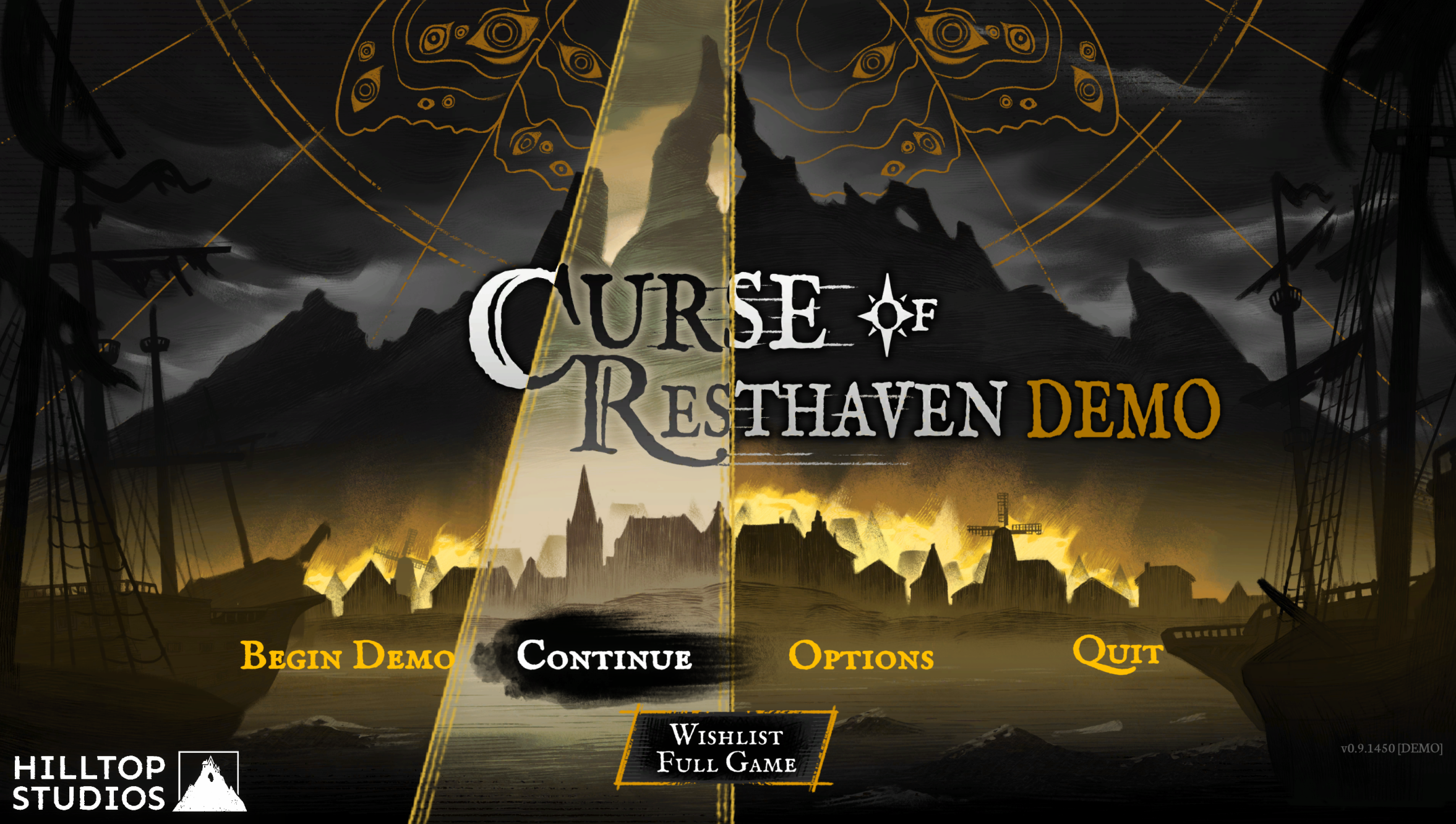
This guest post is written by Katya Ryabova.
Time takes on a slippery quality when you’re playing “Curse of Resthaven.” One minute you’re sitting at your desk, bathed in afternoon sunlight, investigating spooky mysteries and trading with merchants from faraway lands. You blink, and it’s suddenly dark; the family is asleep, while you mutter under your breath, “One more day…”
You’re Ambrose, an imperial courtier in a dashing coat, setting foot on the remote island of Resthaven as the newly minted governor of the struggling colony on its shores. Unsurprisingly, you arrive to hostility, both from the town’s residents and the island itself. You must use limited resources at your disposal to correct the colony’s course while also looking for your niece Amalia, who disappeared on Resthaven several months prior. The residents are hiding something. The island isn’t what it seems. Beyond the town walls, otherworldly horrors await.
“Curse of Resthaven” is the second game by Toronto-based five-person Hilltop Studios, a wide swing and a big departure from their debut title “Lil’ Guardsman”, which I would describe as “Papers, Please! but make it cute”. One way to describe “Curse of Resthaven,” according to the studio director Scott Christian, is “Edgar Allan Poe meets Twin Peaks meets Lost.”
“At its heart, it’s a creepy mystery,” says Christian. “We started with a story: a cursed island, eldritch horrors, a failing colony, and a new governor searching for his missing niece. From there, we asked what mechanics made sense for that world. Trading, town management, interrogation, and choose-your-own-adventure-style expeditions all grew naturally out of that premise.”
On paper, the game sounds like a monster mash of genres as unlikely as it is risky: a gothic horror mystery detective story, a resource management sim, a deckbuilder-lite with roguelite elements, with a puppet show thrown in to boot. This blend of mechanics shouldn’t work — but it does. It takes a few runs to get the hang of them, but once they click, all puzzle pieces fall into place. Collecting goods to sell, trading and haggling with merchants, and expeditions all rely on having the right cards in your deck, I mean, inventory. Keeping track of it all requires patience and practice — the game’s tutorials do their best, but make more sense in hindsight, once the player is more familiar with the game’s rhythm. The game doesn’t hold hands in explaining some of the more granular aspects of running a colony.
Expecting the player to figure it out by trial and error is quite realistic, if you think about it. Ambrose isn’t an experienced governor, and the stakes are high for him. His predecessor on Resthaven met a sorry and mysterious end, but that’s just the beginning. Within six days of Ambrose’s arrival on the island, the world ends… for everyone but him. Poor guv is propelled back in time to his arrival for a do-over ad infinitum, until he figures out how to stop the cataclysm.

The time loop mechanic lies at the core of “Curse of Resthaven,” dictating the constraints and the possibilities of engaging with every other aspect of gameplay. The game design attempts to alleviate the inevitable ensuing repetition in clever, but necessarily limited ways. Within each loop, the player is free to establish their own routine and focus on getting the most out of the limited time they have.
One wise way to spend time on Resthaven is to embark on expeditions, which require resources and coin to initiate. Completing several is needed for the game’s progress, but seeing as many of them as possible was one of the highlights of my playthrough. As story-within-a-story vignettes, they serve some of the most memorable art and the creepiest encounters in the game, and, more importantly, offer glimpses into the island’s lore and the plight of its inhabitants.

Engaging with the colorful characters and the investigation that brought Ambrose to Resthaven in the first place should always stay top of mind. The only way to figure out where Amalia is and what the hell is going on in general is to talk to people who live there. Every person requires their own careful approach. Ambrose has limited dialogue attempts with each NPC every day. Asking about the right topic at the right time may unlock another thread, another clue… Or it may be a dead end or a red herring.
“Instead of collecting a traditional adventure game inventory, players collect topics: names, rumors, and discoveries they can use to question other characters,” explains Christian. “Conversations also cost time, giving interrogation a strategic role within the wider game.”

Time loop after time loop, Ambrose is closer to the truth, but once it’s unveiled, the story doesn’t stop there. The game encourages you to get going and try again, teasing the possibility of the story unfolding differently. Three playthroughs are needed for the “true” ending—not for the faint of heart or those lacking patience! Without spoiling it, I can tell you the story payoff is worth the effort. How many players get there remains to be seen.
The careful threading of NPCs’ stories and backstories, their motivations, drives, and failings, is where the narrative strength of the game really shines. The town of Resthaven truly comes alive through each of its characters, in no small part thanks to the impressively ranged, beautiful voice acting. Underscored by a haunting original soundtrack, a handful of the catchiest tavern ballads you could possibly hope for, and hand-drawn 2D art that cleverly contrasts the colorful town with the black-and-white bleakness of the hostile world outside of it, “Curse of Resthaven” does leave an impression that lingers long after the credits roll.
Image credit: “Curse of Resthaven”


Leave a Reply