
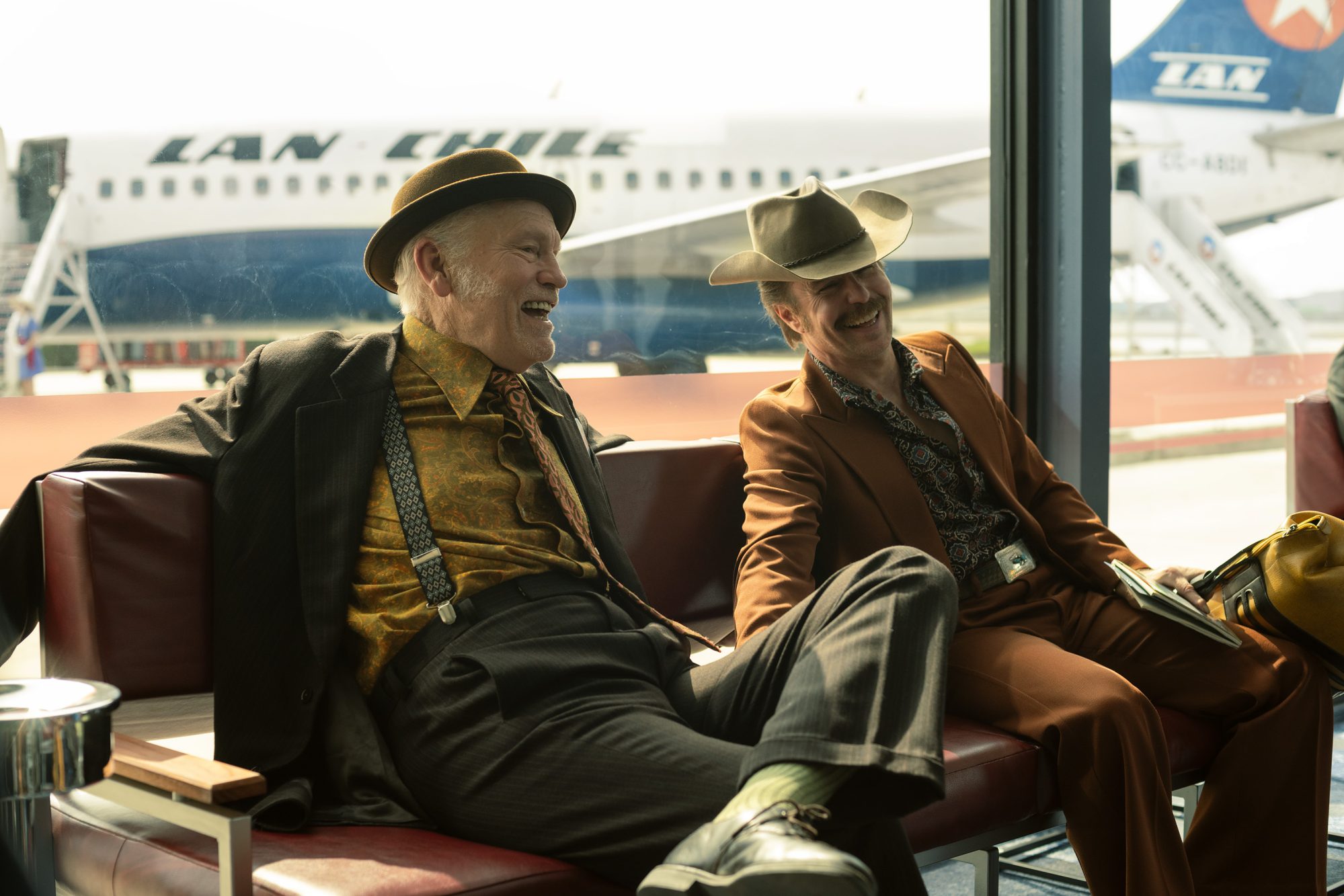
In “Wild Horse Nine,” the Moai, or the Easter Island heads, gaze out mournfully at the sea, their kingdom having long subsided. It’s hard not to read John Malkovich’s performance much the same way, as a reflection on an American empire in its death throes.
For someone near the forefront of cinephile consciousness for nearly twenty years, Martin McDonagh has made a scant few films. His latest bleak comedy is only his fifth feature, but it plays like a career capstone, both for the writer-director, and for its captivating star. Malkovich — an elder statesman actor now in the fifth decade of his film career — delivers piercing and wonderfully symbolic work as a CIA operative in 1970s Chile. The film as a whole treads familiar territory for McDonagh, who struggles to make it stand out. However, Malkovich’s powerful performance, set largely on a secluded island, transforms the movie into a confrontational question on modern isolationism: when did the American century of humiliation truly begin?
The film opens in Santiago, as U.S. intelligence agent Lee Chesterfield (Sam Rockwell) interviews his aging mentor Chris Carlisle (Malkovich) on film, in what turns out to be a darkly funny commemoration. Carlisle boastfully admits to his involvement in various CIA overthrows in the ‘50s and ‘60s, and candidly hints at having a direct hand in JFK’s assassination. This places “Wild Horse Nine” in playfully conspiratorial territory, but it also speaks to the frankness with which these characters approach political killings.
As the agency plans the forthcoming coup led by General Augusto Pinochet, the central duo takes a trip to Easter Island, for reasons that slowly come to light. Along the way, Carlisle, with strangely effortful delivery, shows off to a pair of young Chilean women about his role in the destabilization of their democracy. The claim is so outlandish that they don’t take him seriously (this is helped by Chesterfield’s dismissal of Carlisle’s trumpeting), but something cognitively strange is in the ether.
Alongside a temporal disconnect of subject matter — from details of the coup to distinctly contemporary lines of dialogue about autism and indigenous discourse — there’s an eeriness to Malkovich’s comedy, a vacant look that occasionally gestures at an awareness of the future, and of the character’s mortality. That Carlisle soon admits he’s dying comes as no surprise; you can feel it long before the revelation.
Hoping to fill the holes in his crumbling memory by penning an autobiography, Carlisle’s pointed dialogue — “I’ve been thinking about writing my mem-MOIR” — distinctly recalls another CIA role Malkovich famously played, in the Coen Brothers’ 2008 farce “Burn After Reading.” This particular throwback doesn’t feel accidental, nor does the premise of “Wild Horse Nine” which, like McDonagh’s darkly comic arrival that same year, “In Bruges,” features a pair of professionals reflecting on their actions in a spiritual, perhaps even purgatorial setting.
Granted, in execution, “Wild Horse Nine” is more akin to “Seven Psychopaths” than any of McDonagh’s other movies, in that it spends an inordinate amount of time wheel-spinning through overlapping insults. However, each moment Malkovich is the central focus, the movie springs to life in deeply conflicted hues, as it becomes about a man reminiscing on his life and all the terrors he’s wrought on other people. Which is by no means to suggest McDonagh is trying to draw sympathy for Carlisle’s actions; in fact, the character himself may not even feel that bad. But everything Malkovich’s performance represents ends up crystalizing the movie’s political themes far better than its winding, repetitive plot.
There’s a hesitance to Malkovich’s delivery, as though Carlisle’s cognitive decline had ensured the words don’t flow quite so easily, from an actor otherwise known for his florid, theatrical delivery. In his vacant stares, you can catch glimpses of Malkovich’s Lenny in Gary Sinise’s 1992 film adaptation of Steinbeck’s “Of Mice and Men.” And, in the moments Carlisle comes back to himself, it’s hard not to recall the satirical sci-fi of Spike Jonze’s “Being John Malkovich”, in which the actor — playing a fictitious version of himself — has his consciousness occupied by other people before returning to his own brain.
However, the most overt connection to Malkovich’s filmography continues to be Osborne Cox from “Burn After Reading,” a CIA officer let go for his drinking problem, whose leaked memoirs cause a minor stir in Washington DC. Just as the Coens used this setup to create a defining Bush-era parable — a film of spycraft steeped in well-meaning idiocy — McDonagh updates this premise for a darker period in American history, around a related story of the CIA trying to stop Carlisle from publishing.
Where “Burn After Reading” bridged the Bush and Obama eras, as a film about a more temporary political paranoia, “Wild Horse Nine” seems to more acutely recognize the broader history of American imperialism, and it treats the United States of 2026 as an empire near its end. Just as Carlisle is slipping away on screen, so too is the current superpower he helped create some five decades ago, which not only refused to learn from his mistakes, but built its palaces atop them.
The film may be set more than fifty years in the past, but its modern concerns take shape in Malkovich’s mournful reflections — an almost Eichmann-like recognition of Carlisle’s actions, without a complete emotional understanding of them. There’s no reckoning for the character beyond the walls of his own mind slowly closing in, a deep anguish to which Malkovich seems resigned as the clock runs out. Each strained delivery of dialogue conjures thoughts of a man with few remaining scruples, except for a pair of young women he meets on Easter Island, and who he warns about the coup out of concern for their safety.
Carlisle is still a miserable figure who seems beyond caring about society at large — he mocks the women’s attempts at protesting for their rights — but the further we get into the movie’s runtime, the more he seems like he’s had his blinkers peeled back ever so slightly, as though the looming hand of death had begun to make his life flash before his eyes.
It’s a powerfully-rendered performance, one that elevates otherwise middling material into something like a dying gasp, arriving at a political precipice near the end of the Trump regime. Fittingly, just days before its release, even red enclaves in the country’s south voted against this administration’s failures in historic midterm elections. Whether or not this changes anything in the long run, it’s a decisive indicator that history will be unkind to those in power, whether or not they have enough emotional awareness to recognize this for themselves.
Through Malkovich’s eyes, McDonagh crafts an abstract personification of the current political moment, wherein the past comes into focus alongside brief, melancholy reflections of a country, and a world, under siege by people to whom causing harm is practically second nature. It’s a film of callousness forced to witness itself at a time of judgement.
And yet, the character of Carlisle doesn’t bow to the dramatic demands of an audience demanding retribution. On some level, he can’t. He may no longer be capable of truly feeling remorse — if he ever was in the first place — a terrifying distillation of the callous authoritarianism taking hold the world over. Malkovich merely gives it a human face, in the hopes that we might soon be able to reckon with the parts of the human condition that make fascism a mundane reality.
Image credit: “Wild Horse Nine”
This guest post is written by the best in the business, world class film critic Siddhant Adlakha.


Leave a Reply