
This guest post is written by Siddhant Adlakha.
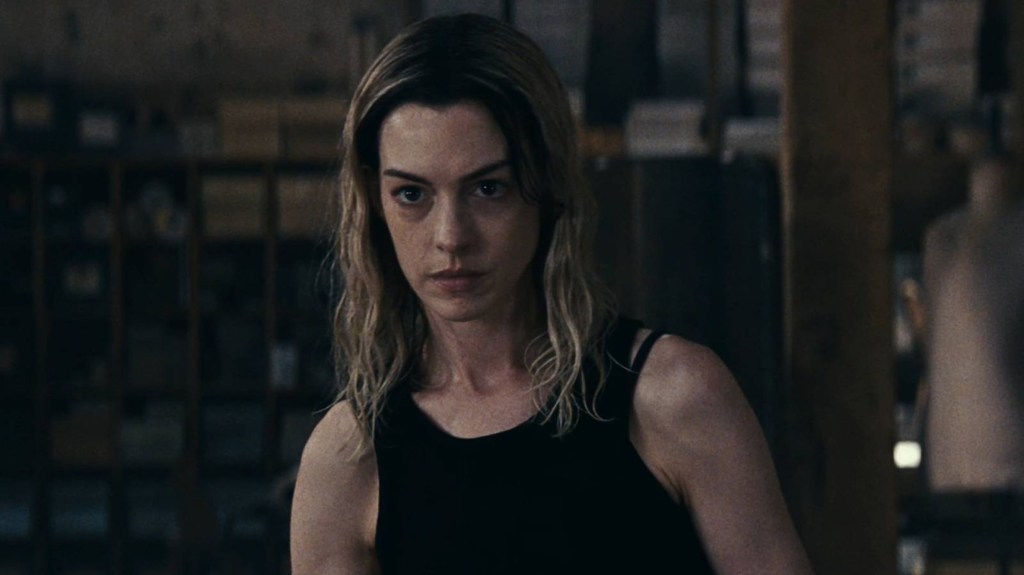
A straightforward premise brims with the promise of psychodrama in “Mother Mary,” David Lowery’s occasionally phantasmic but unfortunately languid pop star saga. Anne Hathaway plays the eponymous superstar, whose return to the stage after several years comes with a fitting existential crisis — not to mention, a crisis of fitting. Unsure of how to still dress authentically, she seeks out her estranged former gown designer Sam Anselm (Michaela Coel) for an uneasy reunion that hints at past frictions without really delving into them.
Lowery’s tale — which began filming 2023 and finally rolls out this week — is nominally about artistic collaboration and the bounds of creativity. The “Ghost Story” and “Green Knight” director occasionally expresses these ideas through eager aesthetic exploration. Shot by cinematographer Rina Yang (of several Taylor Swift videos), it’s a gorgeous film to boot — as it should be, given its fashion-forward subject — but it also ends up paper-thin in most other departments. While its introductory images are untethered from time, gesturing towards vital memories through briefly grainy texture, the story initially plays out in the visage of a black box stage play, wherein the exchange of dialogue in a confined space (Sam’s English countryside workshop) is the flavor of the moment.
Upon Mary’s desperate arrival, Sam offers little but bitter coldness, even as she accepts the undertaking of dressing her for her comeback in a matter of days. Her one condition is total freedom, though this still means probing the pop star’s doubts and dreams for inspiration, resulting in a number of intriguing ideas surrounding their collaboration, and a particularly compelling scene in which Mary performs her upcoming dance routine in total silence. However, in its latter half, “Mother Mary” sometimes escapes the confines of its workshop setting in order to make way for several chimerical flashbacks, many of which center an amorphous spirit akin to floating fabric — a luxurious stole that floats as if mid-transubstantiation, and upon which the concept of ecstatic inspiration is forcibly projected throughout the film.
Although Lowery is careful never to have the characters details his underlying themes(religious or otherwise), they come awfully close to holding up signs listing all the relevant explanations the longer the camera lingers on them, and the more that wind fills extended silences. The movie forces viewers to wait, and wait, and wait until thuddingly obvious parables to click into place. In fact, Mary practically lampshades this M.O. by telling Sam she can’t wrap her around the designer’s many flowery metaphors, though this doesn’t make Lowery’s clunky approach go down any easier.
And yet, it’s hard not to be charmed by the movie’s efforts, if only seldomly. This is thanks in enormous part to Lowery’s chosen performers, who seem eager enough to scrutinize the script and setting for underlying meaning, whether or not it truly exists (and if it does, whether it takes compelling-enough narrative form). As Mary, Hathaway arrives forcefully and filled with self-doubt, even though the movie fails to adequately create a mythology or air of enigma around her Madonna/Lady Gaga-like figure. It certainly doesn’t help that the echoing pop tracks themselves are flat and unmemorable, but thankfully, one of Sam’s conditions is a refusal to listen to any of Mary’s music, given their unpleasant past.
Despite the vagueness and obfuscation surrounding the duo’s dynamic, Coel puts on a clinic of a performance, layering a withholding emotional posture atop a sense of self-identity that begins to subtly crumble when Mary re-enters her life. Together, both actresses perform a kind of cinematic epigenesis, as they help transform the film from one of dashed professional dreams into a dreamlike experience that skirts supernatural boundaries. However, despite its many abstract flourishes, the story underlying “Mother Mary” is never lucid enough to weave emotional tethers—whether between the audience and the characters, or among the characters themselves.
The nature of their past relationship and ensuing fallout is never quite clear, and while we needn’t know all the details, this particular lack of clarity leaves a nagging black hole. For instance, it’s initially uncertain (until Sam eventually refers to Mary as her “friend”) what the duo’s deal is — perhaps they were involved and had a messy breakup? — but any possibilities are ones you might need to intellectualize, out of logistical curiosity, rather than be compelled to determine emotionally. In the hypothetical that there was in fact some intended queer undertone, “Mother Mary” involves only the queerness of presumption laced with plausible deniability; that even ardent shippers might not find much to latch onto here is kind of a problem.
It’s a story that, whether the characters are friends or former lovers, offers little by way of real pain or pathos between them. So, when the movie eventually swerves towards supernatural abstraction, its inquiry continues to live only on the surface. It never dives deep enough into what Sam and Mary’s foundation originally was — even through roundabout motions — to make their current, discombobulated dynamic feel real, or pressing, or potentially solvable. How do you dramatize fixing something if your audience can barely tell where the crack is?
Granted, the lack of certainty around their dynamic is hardly accidental, and dovetails nicely into Lowery’s use of striking visual symbolism as a primary tool. However, even his use of Catholic imagery and garb is limited only to the notion that Mary might have once been a provocateur. He rarely makes us privy to those provocations, and thus, to the nature of her partnership with Sam, her most vital creative partner. As pretty as “Mother Mary” may look, it’s left feeling frustratingly incomplete.
Image credit: “Mother Mary”




 Video Game Town