
This guest post is written by the best in the business: the world class film critic Siddhant Adlakha.
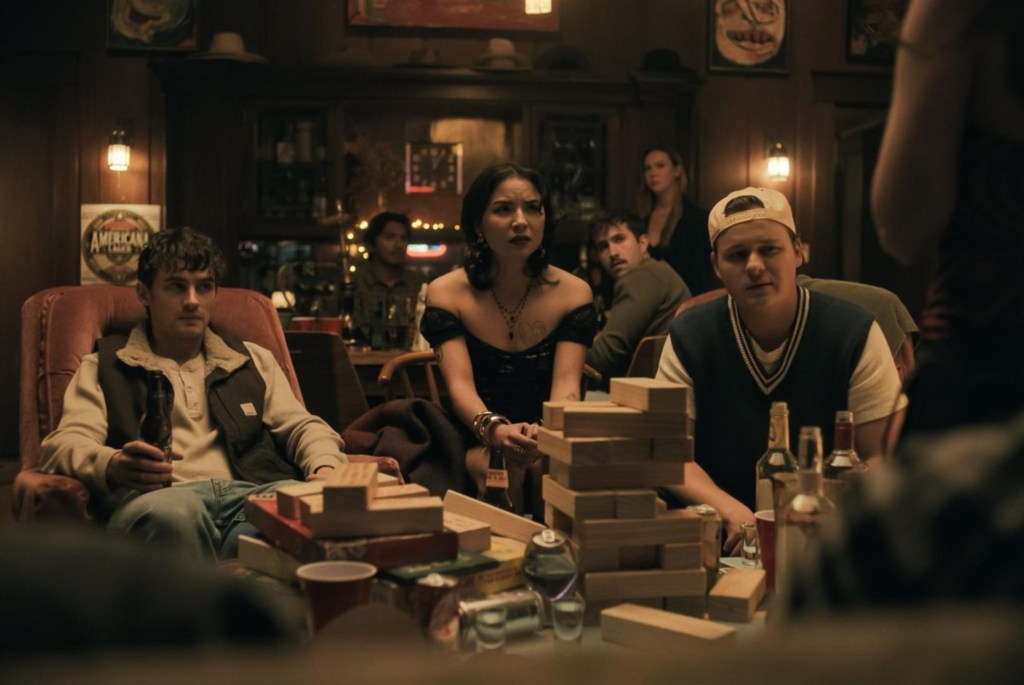
Skeevy “Obsession” protagonist Bear (Michael Johnston) should’ve been careful what he wished for—not because the film is a “Monkey’s Paw” scenario of hidden implications, but because he gets exactly what he wanted. Upon snapping a mysterious novelty charm, a One Wish Willow, the young music store employee asks that his long-time crush and coworker Nikki (Inde Navarrette) fall madly in love with him, more than anyone in the world. Before long, his demand proves too strange and suffocating, yielding a startling, spine-chilling horror-thriller made with remarkable skill.
The resultant film, made for a paltry $750,000 by twenty six-year-old YouTube sensation Curry Barker, has — alongside Kane Parsons’ “Backrooms” — taken the U.S. box office by storm. Distributor Universal (which purchased the film out of the Toronto International Film Festival) even pushed back its digital release after its third blockbuster weekend. Few independent horror films have enjoyed such fanfare week-on-week, but its success is well-deserved, owing to a tremendously taut aesthetic approach. The film is, most certainly, open to interpretations, but they all stem from the primary source that is Barker’s craft, which uses light, sound and performance to twist and tighten every possible screw.
The broad strokes involve the lonely, soft-spoken Bear pining after the radiant, flirtatious Nikki at a distance, and without being straightforward enough about his intentions when he drops her home one night. Post-wish, however, the friendly, seemingly uninterested object of his affections takes on an eerie, wide-eyed disposition, as she gradually tries to ensnare our “nice guy.” Of course, he holds all the cards. Bear knows, or at least has some idea, of what lies beneath Nikki’s sudden change — which, by the way, affords “Superman & Lois” standout Navarrette an impeccable performance.
She plays not only a real person, but performs a fantasy version of Nikki essentially written by Bear, in the vein of fantasy rom-com (but secret horror movie) “Ruby Sparks.” Her self-aware exaggerations are tinged with a knowing, voracious appetite, but all the while, the “real” Nikki, suppressed by the will of Bear’s desire, occasionally peeks out from beneath this façade, turning her story immediately tragic in the vein of “Get Out” supporting character Georgina (Betty Gabriel) — actors who balance a delicate duality by playing both a metaphysical door, and a trapped victim desperately banging against it.
The thematic implications of this dynamic range from Bear’s skirting of basic consent, to Nikki’s behavior resembling Borderline Personality Disorder — writer Arielle Lana discusses seeing her mood swings reflected in the character — but whatever these interpretations, they’re a secondary (and certainly, a necessary) outcome of Barker’s visceral scene construction and the basics of his premise. Less visibly discussed is the fact that Nikki’s demeanor is, at its core, an echo of Bear’s own intentions, reflected back to him by the most disquieting of human shapes.
Beneath Nikki’s ping-ponging moods, and her erratic possessiveness, lies the fundamental reality that she’s trying to control him—which stems from his own act of manipulation, an original, mystical sin, which he can’t seem to undo. This is hinted at in the very first interaction between Bear and the “new” Nikki — the “freaky Nikki,” as he calls her — when, in a scene of him dropping her home, he waits to deploy the information that his cat has just died, as though using this tidbit as emotional bait to lure her into comforting him. After all, revealing this to his other coworker, Sarah (Megan Lawless), earns him a frisky hug earlier that night.
As soon as Nikki “transforms,” she tries to lure him inside with exactly this story: she claims to have lost her cat, when she doesn’t actually have one. The lie she tells changes rather quickly, as though the entity possessing her were learning to navigate truths and un-truths in real time. However, this force is, implicitly, none other than Bear himself — or rather, an externalization of his own opportunistic social mode, taken to its most logical, most violent extremes.
Navarrette’s carefully choreographed body-language and childlike emotional dysregulation make Nikki haunting and unpredictable, especially as Barker and cinematographer Taylor Clemons gradually reflect light sources in her eyes while obscuring the rest of her face and form. Before long, she’s little more than a human-shaped embodiment of unfettered fixation, ready to explode at any moment. She’s little more than a silhouette in several scenes, a chasm representing the darkness that underlies Bear’s own deepest desires to control her, and to rob her of her autonomy, which manifests as her failing to take care of herself when he isn’t around.
That Bear comes to regret this predicament has less to do with Nikki’s personhood, and more with the constant attention destabilizing his daily life (among some other very gross and gory happenings). Everything that transpires is delightfully macabre, but none of it is out of the realm of possibility, especially when one considers that this is exactly what Bear wanted in the first place, as though he had poisoned her heart and mind to be more like his own.
“Obsession” is a film of movement through light and shadow; of negative spaces that gradually induce dread; of chilling ethical conundrums, whose dimensions stem first and foremost from twisted cinematic fun. It’s a well-earned success story, in which one young man’s simplest desires are magnified back to him in a gendered form too often reductively labelled “crazy”—see also, the Latina “toxica” stereotype—without considering how a quieter, more sinister male equivalent can be just as psychologically damaging, or worse.
If nothing else, it’s a story how this archetype may as well be a projection of masculine insecurity, and an oft-ignored double standard, wherein the most overbearing affection becomes terrifying when imbued with distinctly masculine forms of control. Donald Glover said it best: “Every man has a ‘crazy woman’ story… Why don’t women have ‘crazy men’ stories? And then I realized: ‘Oh, if you got a crazy boyfriend, you gon’ die.’”
Then again, that’s just one of the many readings to which “Obsession” so vividly lends itself. At the end of the day, Barker’s artistic affectations cause the story to crawl beneath your skin, and live there until you’re forced to extract it, along with whatever meaning you find most intimate and unnerving—as any good horror movie should.
Image credit: “Obsession”


 Video Game Town
3 responses to “Curry Barker’s Unnerving ‘Obsession’ is the Year’s Most Remarkable Horror Breakout”
[…] The Best Movies To Watch With Your Dad This Holiday Season The March To Middle Age Curry Barker’s Unnerving ‘Obsession’ is the Year’s Most Remarkable Horror Breakout From YouTuber Kane Parsons, A24’s Intriguing ‘Backrooms’ Completely Derails […]
LikeLike
[…] Reduce Itself To Trite ‘Burn The Witches’ Storytelling? Curry Barker’s Unnerving ‘Obsession’ is the Year’s Most Remarkable Horror Breakout ‘Mother Mary’ Looks Immaculate, But Feels Emotionally Hollow Pedro Almodóvar’s […]
LikeLike
[…] Curry Barker’s Unnerving ‘Obsession’ is the Year’s Most Remarkable Horror Breakout […]
LikeLike