
This guest post is written by Isabel Ravenna.
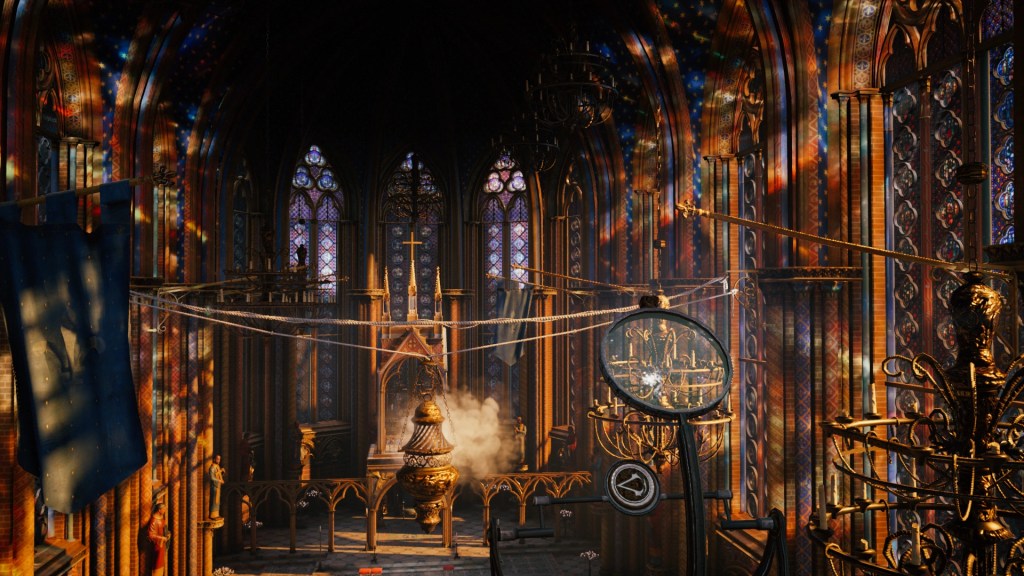
Every game inspired by the past faces the same accusation: not historically accurate. “Ghost of Tsushima” saw sword-fighting where there wouldn’t have been, “Kingdom Come’s” emperors lost all political nuance and “Assassin’s Creed: Unity” had doorknobs. Doorknobs! Items which wouldn’t have been invented for another 100 years. But these judgments for things that never promised to replace history class, often distract from the fact that they’re still making millions of people care enough to learn history in the first place.
“As a historian and gamer, I am not as concerned with historical ‘accuracy’ in video games,” wrote Draper Natural History Museum curator Corey Anco. “Like all historical media, including written textbooks, films and television shows, historical video games are educated guesses about past events… Instead, I am concerned that video games respect the past.”
Dramatizing, even fabricating, is a universally-accepted practice in turning historical events into modern entertainment. Christopher Nolan did it in “Oppenheimer” as Kristin Hannah did with “The Nightingale.” But as academic scholars have long noted, history is an ongoing process of reconstruction, piecing together past events, lives, details and societies using remaining information — information to be learned and portrayed through art.
One University of Tennessee professor developed a course completely inspired by “Red Dead Redemption,” inviting students to learn about turn-of-the-century America by experiencing it. As the ancient Chinese proverb goes, “It’s better to see something once than to hear about it a thousand times.”
Anybody who’s played “Battlefield 1” remembers the whiplash of waking up from a Mama Cass-accompanied dream to the brutal reality of being on the front lines of World War 1. And before gaining access to the trigger of a machine gun, a message: “More than 60 million soldiers fought in ‘The War to End All Wars’,” the title screen immediately reminds players. “It ended nothing.” And suddenly the virtual targets feel different.
Players who’d become immune to “Call of Duty” and “Halo” first-person shooter games realized the gravity of their controller and what “XP” suddenly represents. Each explosion and every kill teaches something that a textbook full of geopolitical conflicts can’t: “You are not expected to survive.” Because the stakes from the actual Western Front in France were much higher than that of your $200 gamer chair, and millions of people who felt the warmth of the explosions mimicked by a speaker didn’t respawn.
While a museum might be able to show you an actual gun — a relic that took real lives — games show systems, inviting you inside of cities, showing how trade worked, how religion shaped life, how geography mattered and what daily routines looked like.
As author Mark Patterson once said, “Nothing teaches you more than exploring the world and accumulating experiences.” And though he never specified the kind of world, digital ones are often the reason modern people embark to explore the real one. The “Ghost of Tsushima” developers were named permanent tourism ambassadors after the success of their game, with fans famously raising over $200,000 to repair a storm-damaged torri gate that they’d long admired through their PC. “Assassin’s Creed II” lovers frequently visit Florence, Italy to walk the exact Renaissance streets they’d seen one hundred times, just 527 years into the future — or present.
In this way, historic games are doing more to inspire pilgrimage than rewrite history and much like the “Red Dead Redemption” professor, museums are noticing.
Ubisoft even stripped the combat, enemies, and time limits from “Assassin’s Creed” and lent historians its historical settings to guide virtual tours within while teachers get certified in “Minecraft” in order to teach history through the digital recreation of its structures.
By then, games had already begun its evolution to legitimate public history — successful teachers to be taken seriously.
“I played a lot of [‘Kingdom Come Deliverance’] and I have to say, while I enjoyed it a ton, it made me appreciate games with less historical accuracy more,” wrote one Redditor. And maybe that’s because some games teach something bigger than the dates of important events: history made of ordinary people living realistic lives and the gritty realities of a time modernity continues to learn from — which is something that an interactive medium is uniquely capable of simulating.
So while a game might not be a direct translation of your high school’s required reading, more than convincing players that something happened — it allows us to understand how places sounded and make the most inconceivable of decisions; ones that only the son of the village blacksmith in 1403 might have faced, and how the circumstances of real people produced options that have been long eradicated from modernity.
Image Credit: “Assassin’s Creed: Unity”
 Video Game Town
Leave a Reply