
This guest post is written by, pound for pound, the best working film critic in the world: Siddhant Adlakha.
“If you’re not careful and you noclip out of reality in the wrong areas, you’ll end up in the Backrooms.”
So began an anonymous 4chan post in 2019, accompanied by an eerie image of what seemed like a musty workspace of infinite twists and turns. From there, a crowdsourced folklore grew, eventually leading teenage creator Kane Parsons to kick off a found footage web series, which would garner millions of views. Its mythology became as sprawling as the liminal yellow hallways at its core, now the subject of Parsons’s very own feature, produced by A24.
However, crafting a straightforward narrative around the concept proves too challenging for the young upstart, even though at just 20 years old, he demonstrates commendable tonal control at times, and remarkable technical skill. Unfortunately, by the time “Backrooms” decides what it wants to be — quite late into its 110 minutes — it’s already derailed.
The film begins in intriguing fashion, with found camcorder footage from 1990, as an unseen scientist or explorer makes his way through a series of winding, never-ending corridors littered with furniture, lost signs (some of them reading backwards), and other paraphernalia. These objects appear to have half-materialized through the walls and floors of this windowless labyrinth, around whose corners seems to lurk some unseen force that sets the cameraperson’s teeth on edge — not to mention, that of the audience. This chilling prologue is akin to Parson’s YouTube shorts, told with the same lo-fi, handheld aesthetic, but before long, the young filmmaker pulls back to tell a more traditional, character-focused story.
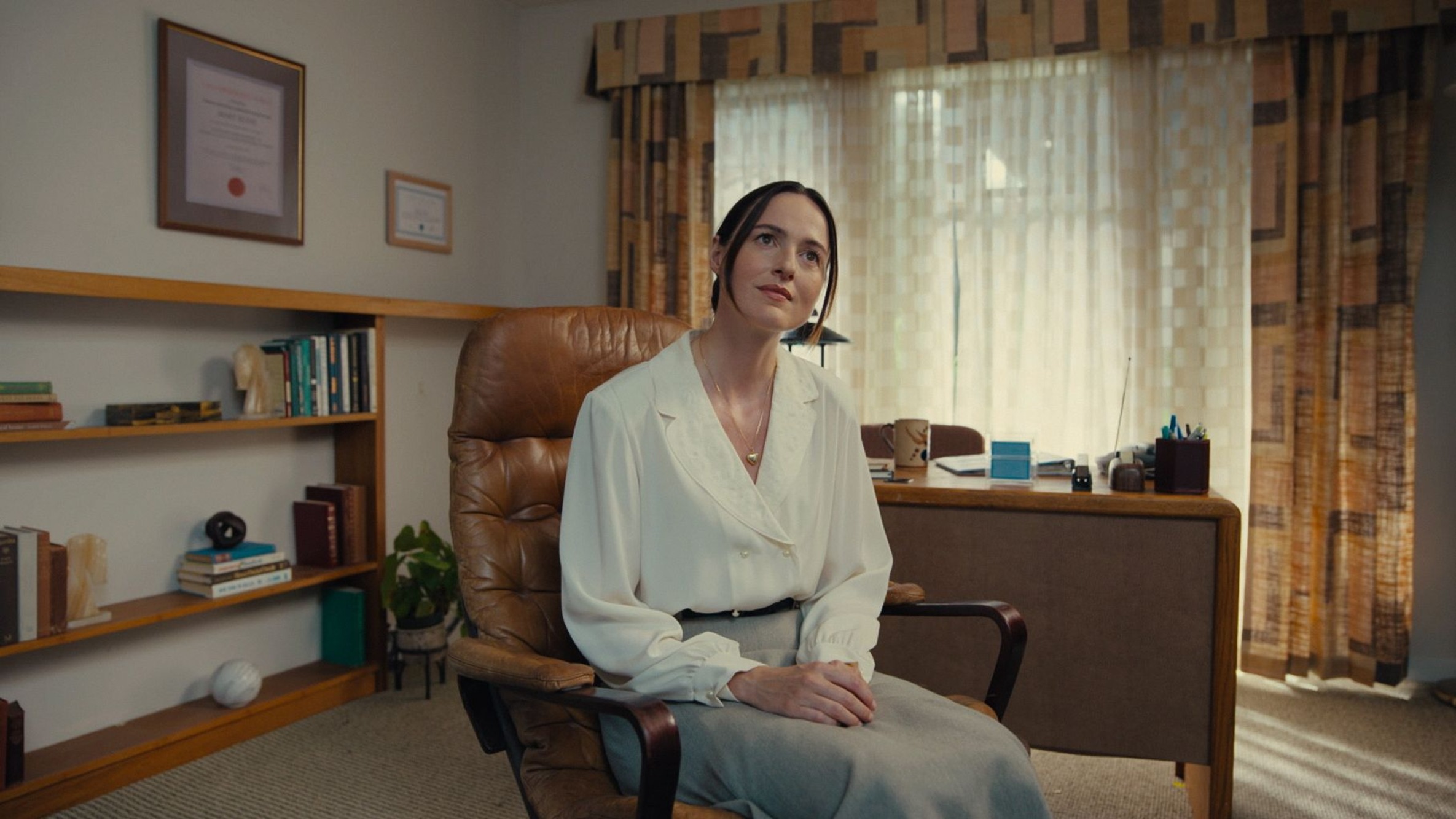
In its initial moments, “Backrooms” beats with audiovisual ingenuity, presenting therapist and supporting character Dr. Mary Kline (Renate Reinsve) through a childhood memory that seems to overlap with waking reality in an unnerving manner. If there’s one thing you can tell about Parsons as a moviemaker, it’s that he loves the mischief of blurring lines and expectations, down to a chilling musical score where jagged notes overlap with the diegetic sounds of heavy objects being dragged across a creaking floor.
But before the film goes full-tilt with its liminal horror, it gradually introduces one of Mary’s patients, Clark (Chiwetel Ejiofor), a struggling furniture store owner and troubled alcoholic, whose electricity bills have been mysteriously high, even when the store has been closed.
Soon, Clark discovers what’s been pulling the excess power, after an impossible tumble through a basement wall — left entirely intact — lands him at the beginning of a sprawling yellow hallway with oppressive fluorescent lighting and impossible dimensions. It’s here that we get our first real taste of the titular backrooms, through a more traditional cinematic lens that refuses to obscure its details.
As Clark makes his way back and forth between the mysterious portal, he eventually ropes in a pair of young employees to help him trace the room’s seeming infinitude — one of them has a camera, briefly reviving the found footage claustrophobia — only to realize that they may not be alone down there.
Clark’s occupation is more than just a fun easter egg. The original Backrooms image shared on 4chan was eventually traced to a renovated furniture shop in Wisconsin, so the movie’s premise functions as a de facto expansion of the ever-engorging mythos. However, the true mysteries of this space are seldom left mysterious, even though no concrete answers are presented.
Between hints of a scientific force surveilling the backrooms, and endless talk between Clark and Mary about creating mental loops for oneself to avoid dealing with trauma, Parsons gradually imbues his architectural horror with dueling, clunky explanations rooted in rote science and junk psychology. The problem isn’t that none of it can be mapped onto a realistic framework, but rather, that so much of the movie seems to try, practically stopping dead so it can introduce hint after hint of unwieldy ideas that never come to fruition.
Concerned for her patient, Mary eventually follows Clark into the mysterious space, after innumerable flashbacks hinting at her own unhappy childhood (from where she gets the urge to help people). However, by the time the duo reunites in this uncanny space, an entire feature’s worth of psychological, dramatic and plot development appears to have unfolded between the cuts, as the third act follows up a story that practically doesn’t exist. Things get goofy very quickly, with haphazard editing that dilutes the action, an excess of half-baked exposition — it’s rare for a movie to feel both over and under explained — and a rather unfortunate-looking “monster” that the camera can’t seem to decide if it’s obscuring or revealing.
The core issue with “Backrooms” is that its highly imaginative ideas are plagued by unimaginative drama, which leaves it perpetually torn between what it purports to be about and what ends up on screen. More often than not, it plays out in the form of Clark and Mary, either during their sessions or in the mysterious expanse, constantly referring to emotional conflict that’s already unfolded elsewhere.
Despite constant assertions that the premise is a thematic manifestation of their issues — like in recent video game movie “Exit 8,” which turned recursive mechanics into existential despair — “Backrooms” achieves no such metamorphosis in its adaptation, and leaves too much of its dread to the imagination. The series’ game-like explorations end up severely limited here, by the movie’s recursive, back-and-forth plot, which treads only a handful of unique spaces, and becomes incongruous to the notion of unpredictable discovery in infinite permutations. For a film about endless hallways, it feels awfully small.
Parsons’s YouTube snippets have long proven he’s an artist of ideas, but the form of his internet folklore is that of whispers, and details that imply larger stories exploding in the margins. When it comes to turning his camera directly on those quiet peripheries, it’s clear he has a long way to go. It’s hard not to wonder if, instead of traditional drama, someone at the production level ought to have let “Backrooms” be a true expansion of the found footage series, in both concept and form.
The movie, beyond a point, contains little but logistical explanations bearing the appearance of something open-ending; “Here’s a map to the maze,” it says, robbing you of the thrill of getting lost. The mysteries of the backrooms are much more inviting when left unexplained — making it bitterly ironic that these moving pictures worth millions will end up less impactful than a captioned photo shared on an image board, and a handful of DIY digital shorts.
Image credit: “Backrooms”

.jpg)
2 responses to “From YouTuber Kane Parsons, A24’s Intriguing ‘Backrooms’ Completely Derails”
Great review – hate to be pedantic, but the furniture store was found in Oshkosh, Wisconsin – not Oklahoma.
[…] by twenty six-year-old YouTube sensation Curry Barker, has — alongside Kane Parsons’ “Backrooms” — taken the U.S. box office by storm. Distributor Universal (which purchased the film out of […]