
With the autobiographical coming-of-age drama “The Fabelmans” Steven Spielberg carved a delicate skeleton key to the wandering halls of his psyche. His follow-up, the alien conspiracy film “Disclosure Day,” sees him shatter each door with a battering ram. The unique autofiction works wonders on numerous levels, from distinctly modern political sci-fi to a decades-spanning retrospective on the Beard’s inescapable oeuvre. It’s as exciting as heady blockbuster cinema can get, a film so choc-full of ideas that it would crumble under the weight of its own goofy, heartfelt ambition with anyone else at the helm.
But in the hands of Hollywood’s most naturally gifted image-maker, it’s practically a modern masterpiece, and one of the best films he’s made this century.
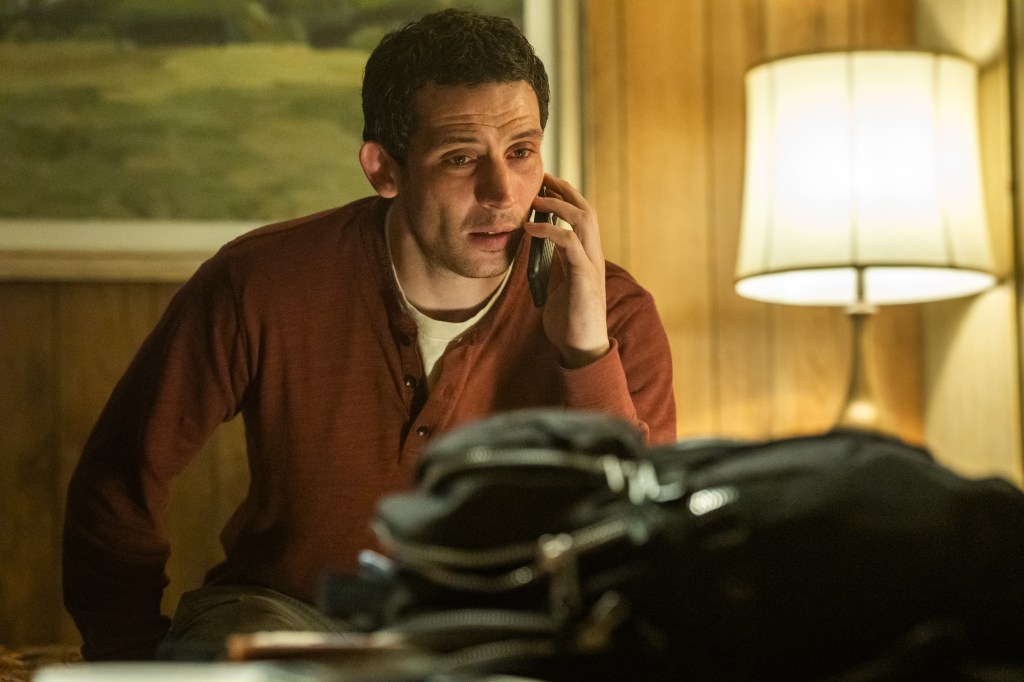
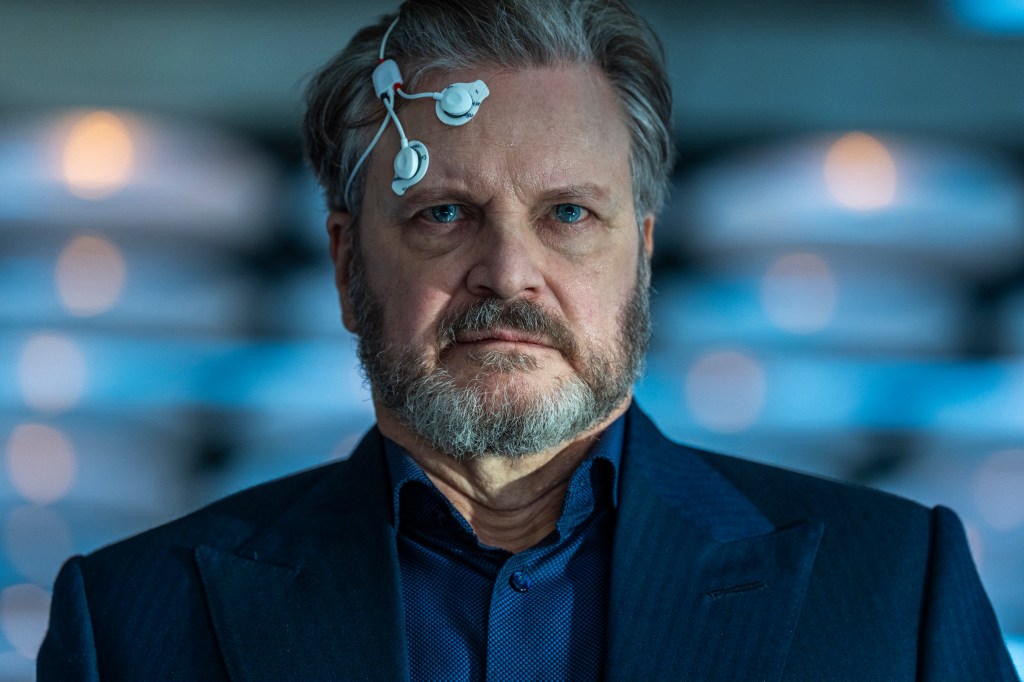
It begins in media res and without much detail, forcing you to piece together its scattered shards. Corporate whistleblower Daniel Kellner (Josh O’Connor) tries to stage a covert meeting at a rural wrestling show, only for his tech billionaire overlords—led by Colin Firth’s sinister Noah Scanlon—to intervene, by holding his girlfriend Jane (Eve Hewson) to ransom.
This quickfire intro plays like a boilerplate studio thriller involving a mysterious oblong device, and a young couple who appear to be keeping secrets from one another, between Daniel’s criminal past and Jane’s history as a nun. However, what appears to be the movie reaching for immediate intrigue turns out to be a sly thematic seeding. Give it your attention during these early speedbumps, and the rewards will follow.
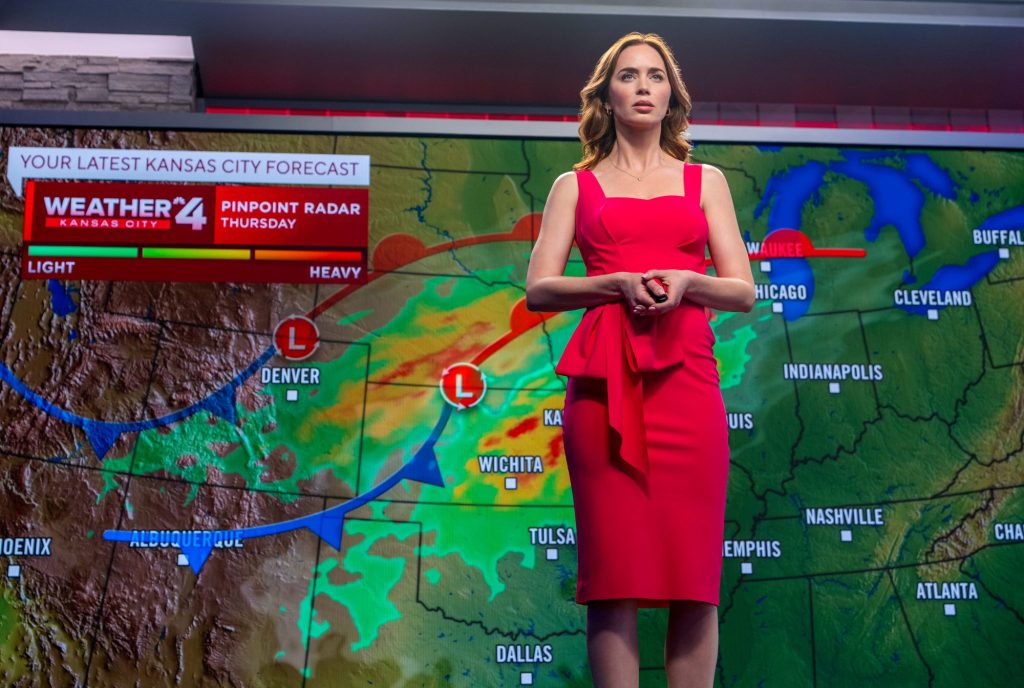
Much more interesting, in its gradual build, is the parallel tale of local Kansas weather reporter Margaret Fairchild (Emily Blunt), whose serious chat with her boyfriend Jackson (Wyatt Russell) over breakfast is interrupted by strange happenings. Before the couple can discuss their future, Margaret locks eyes with a bright red cardinal that flies through her window, which seemingly imbues her with the ability to speak Russian and Korean (among other languages), although she doesn’t realize it.
Fittingly, background chatter at work circles news of state aggression from (and toward) Russia and North Korea, suggesting an oncoming global conflict. Why does Margaret suddenly have these specific skills? Why now? And how does she suddenly learn to sweet-talk her way out of arguments by bringing up factoids about people’s personal lives—which she should not, under any circumstances, know?
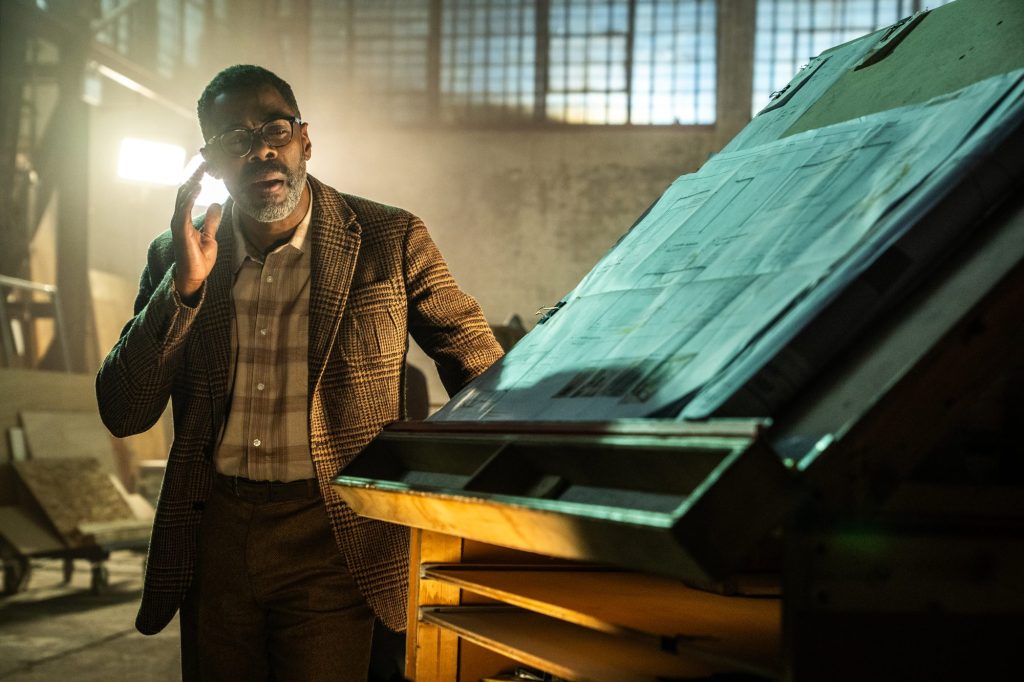
Before anyone but the audience realizes these are questions worth asking, Margaret begins speaking a mysterious dialect live on television, involving guttural clicks. This captures the attention of not only the villainous Noah, and his government-tied tech firm Wardex, but several of his former employees who have turned informant, and plan to release vital information to the public about decades-old secrets. Among them are not only Daniel, but Colman Domingo’s Hugo Wakefield, the apparent leader of this turncoat faction, who can be seen organizing Daniel’s escape in snippets over various phone calls, while also strangely constructing what appears to be a studio set for a nostalgic rural farmhouse.
These disparate concepts soon start to fit together, once the movie’s threads collide in dazzling fashion. But in the meantime, Spielberg crafts a robust suspense piece, wherein the secret presence of aliens is all but confirmed in the film’s initial act. We get quite a good look at them too, albeit by way of the stolen government videos Daniel hopes to make public, should he evade Noah’s gun-wielding mercenaries. However, complicating their capture mission is the fact that Margaret seems to suddenly know things she shouldn’t (and seemingly, doesn’t want to), from Daniel’s location to his motivations. So, she ends up intervening, as if compelled by the narrative’s unseen hand, affording Blunt a powerfully frayed performance as a woman constantly on the edge of a breakdown.
This leads to action a-plenty, beginning with intense anticipation awash in lens flare dispersed by window blinds—as though Spielberg were bringing a noir mystery into the third dimension—and dovetailing to magnificently staged and edited chase scenes, which give us some idea of what Spielberg’s shelved “Bullit” remake might have looked and felt like. In true Spielberg fashion, there’s breathtaking train sequence too—made all the more pulsating by a banger late-era John Williams score—but it’s also built on simpler, quieter moments like an unbroken shot of Daniel trying to sneak through the woods and steal a car unnoticed, a battle between sound and silence that’s just as exciting as any of the bombast.
He knows exactly how the frame should move, but that’s nothing new. In fact, between the remarkable action hubbub and thoughtful camera placement sits a film pieced together from several works Spielberg has made before, though that’s not necessarily a bad thing, given how he strives to locate its story somewhere in the ethereal space between their evolution across the decades.
The mysterious alien device grants Noah a seeming omniscience that takes the form of him appearing before nearly any subject he’s chasing, as though the director were literalizing the technological concepts at the core of “Minority Report”—a movie shot prior to September 11th 2001, but one that became a vital post-PATRIOT Act text, for its scrutiny of surveillance.
Spielberg would subsequently nosedive into the 9/11-inspired alien horror of “War of the Worlds” shortly thereafter—as well as films like “Munich,” about cycles of state violence, and lighter works like “The Terminal” and “Catch Me If You Can,” which bear a particular nostalgia for airports before they were engulfed by paranoia. Few filmmakers have ever sought to process world events to this extent, and his latest is no exception.
Knowledge is power, and power is hoarded, so state overreach ends up at the core of “Disclosure Day,” between the secrets Wardex has been keeping for the U.S. government (including some involving torture), as well as the villain’s ability to wield even the most intimate information as a weapon. This even extends to twisting people’s allegiance against their will. He may as well be a stand-in for the CIA, but there’s an inescapable sense that the movie is about misinformation too—or at least, the use of gifts like instant connectivity to warp perceptions.
When Noah tries to use Jane’s proximity to Daniel against him, his mind-melding persuasions involve contorting her pious beliefs, as though Spielberg were zeroing in on the Christo-fascist evolution of the modern American milieu, as if re-making M. Night Shyamalan’s “Signs” or Denis Villeneuve’s “Arrival” for the age of an Evangelical U.S. government.
However, faith isn’t merely an instrument in the movie—or a query guiding the ethics of public disclosure—but rather, a core fabric that harkens back to the director’s earliest works. Ever since his (now lost) high school feature “Firelight” in 1964, and all through films like “Close Encounters of the Third Kind” and “E.T. the Extra Terrestrial,” Spielberg has been framing aliens through a Biblical lens, from lights in the sky to mysterious beings arriving with their arms spread outward, in Christ-like fashion.
These supreme organisms have, in his filmography, tread a fine line between scientific and religious belief, and have always been used to ask questions of our place in the universe, and how we relate to it. Here, Spielberg probes those very same notions with even more introspective depth, in order to ask how we relate to ourselves, as a world on the brink of implosion.
As a mirror to Noah’s weaponizing of knowledge, the film prismatically splits the very concept of “knowing” between its key protagonists. Daniel and Margaret—through mechanisms eventually explained, albeit revealed explicitly in the trailers—take on practically religious significance in the process, like alien prophets empowered with the most magical problem-solving abilities.
The former, a data analyst, ends up unusually adept at solving and understanding mathematical questions, while the latter can not only effectively communicate beyond borders, but can also sense and even conjure people’s loved ones, in the form of lifelike illusions. Her telekinesis is steeped in empathy, and her weapon takes the form of breaking through the movie’s more naturalistic tones to present operatic appeals to each antagonist’s inner goodness—as though she were conjuring deeply personal melodrama, the way a filmmaker might.
These two halves coming together ends up Noah’s greatest fear, not only because they can use their combined abilities to stop him (and, eventually, to appeal to his better nature), but because they represent the sum total of technical and emotional human intelligence. In a moving meta-textual stroke, they are also manifestations of a great many aspects of Spielberg’s personal life, from his father’s engineering background, to his mother’s artistry as a pianist, and in combination, his own experience as a filmmaker, or an emotionally-driven problem solver.
It’s hard not to see the film’s unlikely heroes as manifestations of his mom and dad. They’re star-crossed archetypes who, although they don’t have a romantic future together—Spielberg is famously a child of divorce, a theme throughout much of his work—are still vital halves of a whole, especially in a moment when Daniel calms Margaret’s anxiety attack (after an adrenaline-fueled chase) by gently placing her hands on a the exposed strings of a grand piano. This may as well be a chapter ripped from Spielberg’s own childhood—“The Fabelmans” makes the claim that he and his mother were both prone to such episodes—but even with no knowledge of the director’s past, the scene works regardless, as a tender reprieve.
At its core, the film is about a breathtaking race to distribute knowledge where it belongs—among the people—lest it be hoarded and weaponized, but it’s also about the cynical commodification of everything from technology, to education, to human experience. That aforementioned stage set, for instance, ends up halfway between a physical and emotional doorway to nostalgia, in service of sci-fi mechanics that treat awe as a vital emotional tool, and wonder as an explicit means to greater self-actualization.
When this becomes the movie’s central focus, through a particularly imaginative flashback, cinematographer Janusz Kamiński even briefly breaks from the bleak, washed-out style in which he and Spielberg have painted since 2001, in order to re-introduce hints of visual warmth—as though a world that broke them, and broke itself, could possibly be imagined through a lens of healing. Along with Spielberg’s newspaper drama “The Post” (with which “Disclosure Day” also shares surprising DNA, as a film that adores local journalism), this might be his most optimistic film in years.
But is all this about Spielberg trying to justify and reckon with his own cinematic approach, especially in the 21st century? Sure it is. But in an isolated context, it’s also a wistful plea for humanity—as a people, and as an abstract notion. In anyone else’s hands, the naked sentimentality seen in the final act might strike a particularly naïve chord, but Spielberg is nothing if not adept at making his images sing.
From his framing of global superpowers as unknown, alien invaders on the news (a brief but effective send-up of media mechanics), to the way even his actual little grey aliens are imbued with recognizably human traits, Spielberg reaches all the way back to the days of “the Roswell incident” and the ensuing Cold War science fiction with which he grew up, and which influenced his own movies, in order to weave a distinct political continuum. This is the world that raised him. And in 2026, he comes to a more enlightened understanding of its best and worst qualities.
For the most part, the extra-terrestrials in “Disclosure Day” exist on other people’s screens. But Spielberg ensures that the most important thing, in these moments of witnessing, is contextualizing not only what “the alien” means in the history cinema—from a cypher of fear, to a reflection of our existential anxieties—but what shared images have the power to do, from disseminating knowledge, to gifting people ephemeral sensations that connect them to everyone and everything around them. And he does it all in the most thrilling possible style.
Image credit: “Disclosure Day,” Universal
This guest post is written by the best in the business: the world class film critic Siddhant Adlakha.



 Video Game Town
Leave a Reply