
This guest post is written by Jacob Linden.
Your next favorite indie game could have been teased at this showcase for New York Games Week. Sponsored by IDGA NYC along with the Mayor’s Office of Media and Entertainment, Game-a-Palooza brought around 50 local indie devs to Brooklyn to showcase a huge variety of games. I had an excellent time demoing games and chatting with the passionate solo creators and small teams making them happen. I didn’t have time to try every awesome-looking game at the show, but came away very impressed by the ones I played.
It was incredible to see the titanic spread of genres devs were working on, and this list is only the tip of the iceberg. All these great games deserve a wishlist, and some of them can even be played now!
MUTAGEN – Developed by Drew Shapiro / Organzola Games

I was very taken by this imaginative 2D exploration game featuring surreal character and environment design that made me think of the early stages of playing a cell in “Spore”. You play as a little white blob that pops out of a bigger blob and sets out to explore this odd ecosystem, coming upon the corpses of your kin that grant you various body parts and modify your platforming abilities. I was munching alien berries and pooping out stacks of blocks to jump up, blowing bubbles that could carry me, and extending my neck to hook onto high platforms. The world is strange and harsh, and I died several times during the demo while learning its hazards and the attitudes of its strange inhabitants, but was thrown back into the action with a fresh blob quickly enough.
The game is the brainchild of Drew Shapiro, who I learned is one of the first graduates of the new Game Design BFA at the Pratt Institute! Drew said “MUTAGEN” was inspired by games like Rain World and Mosa Lina, and you can certainly see the DNA of those obscure, rich platforming experiences here. I only saw one biome in the demo, but I’ll absolutely be keeping an eye out for updates on this game and jumping in whenever I can see more. There’s no current release date, but you can play the “MUTAGEN” demo on Steam now!
Gimme Drive! – Developed by Thomas Quinn / Tea Queue Games

I am not nearly smart enough for this game but still had a great time demoing this puzzler. “Gimme Drive!” has a simple, clean art style with a nice starry backdrop, and some very soothing lo-fi music, but the puzzles quickly start hurting your brain as you get through some simple tutorial levels. The basic concept has you drawing roads for a truck in space that has to enter and leave the level and pick up all the stars along the way, but the truck can only go in a straight line until it picks up a certain color star; blue stars go left and yellow stars go right.
You’re not gonna get a single hint, unless you’re playing with the developer Tom who very kindly gave me some guidance as I struggled with the demo’s last puzzle. It takes a moment to grasp how the turning works and you’ll build a few impossible routes at first, but it eventually feels pretty intuitive to erase segments or jump back to an earlier idea with the undo/redo arrows you’re mercifully granted. Locking the truck’s final path into place does give you a nice eureka feeling, and completionists can replay levels to try and complete them with the minimum possible roads used. Tom sent me a playtest build after the show to try out more, and while I haven’t gotten as nearly far as I want because the game is so damn hard, his puzzles manage to lodge in my brain until I can’t help but try and crack them again.
“Gimme Drive!” is launching later this year, and die-hard puzzle game fans looking for a challenge should absolutely check this out.
Wild Chorus – Developed by Habitat Games

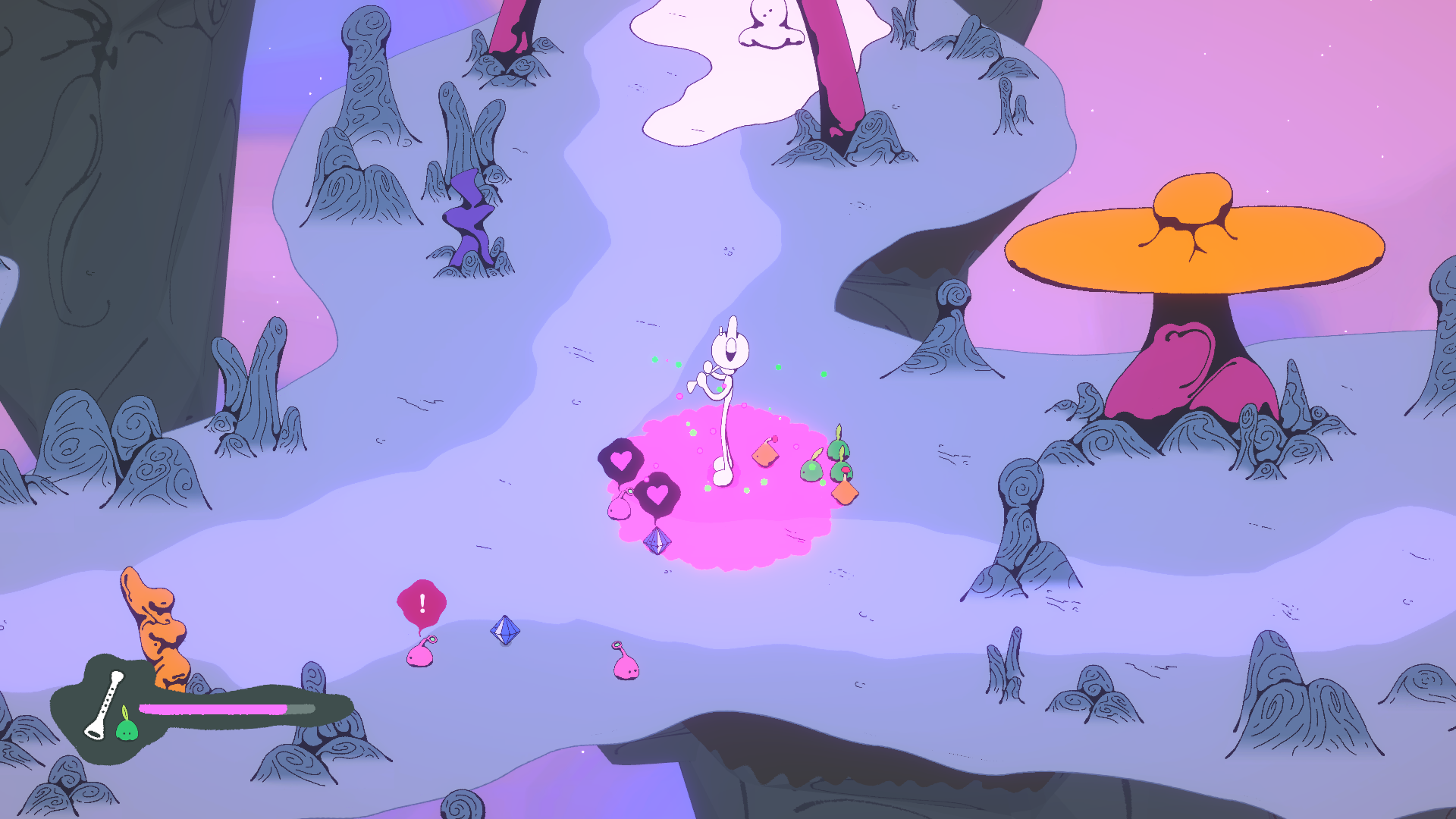
A major highlight of the show for me was “Wild Chorus,” a musical 2.5D adventure exploration game that kicks off with your character Opie crash landing on a strange alien world after some strange musical craft overloads on musical energy and goes haywire. You’ll use your flute to charm cute sound sprites, fight the encroachment of white Silence, meet some fun characters, and build Melodies to restore the world as well as layers of the game’s soundtrack. The vibrant, strange art style was a high point of the demo, and the game’s art director Patrick Edell happened to be showing the game off. “I usually compare it to old school top down Zelda games, but instead of swinging a sword to fight monsters, you’re playing a flute to fight Silence,” Edell quipped before I jumped in.
It felt good to clear out swathes of Silence and small blob enemies, and I got a pang of sadness when my cute sprite buddies got drained of their color when straying too close to it, but they got revitalized with some flute tunes. You can hold a button to play a flat note, but there is also a great free-play system where you can noodle on the flute by flicking the right stick. You charm sprites by following a simple note sequence they display in a satisfying minigame, and then can slot them into items around the world you manipulate for puzzle solving. You’ll also need a big stash of Sprites to clear out huge chunks of Silence and then slot them into Melody notes, which you can even move around a little measure that appears, and change the tone of the Melody based on what color sprites you slot in. I loved hearing the beginnings of a soundtrack take root in the demo, and the choice to make it modular to make the player feel like a conductor of their journey was an inspired touch.
Needless to say, I’ll be watching out for updates on “Wild Chorus” like a hawk!
Fashionistas: Battle of the Babes – Developed by Pineapple Staircase

I had a great chat with Camron Gonzalez and Tasneen Bashir of the dev duo Pineapple Staircase while battling with Bashir in their wonderfully weird dress-up multiplayer battle game “Fashionistas: Battle of the Babes.” The four clothing items you choose for your strange little avatars become your attacks in the turn-based fight, and Bashir said they wanted to lean into an absurd art style and incorporate the combat twist to bring new fans to the dress-up genre. You don’t get to know your moves before jumping in, it’s just about creating a weirdly dressed little guy. “We actually want people to pick an outfit that they like and they’re drawn to, and then see how you fend on the field,” instead of min-maxing in the changing room, Bashir explained. Gonzalez recalled showing Fashionistas to a wide audience at PLAY.nyc in 2025 after the ten week sprint to make the first build of the game as invaluable mass testing to see what moves were over-tuned or not getting picked.
Bashir cited classic browser dress-up games on sites like Barbie.com and GirlsGoGames she played in her childhood that inspired the push to create “Fashionistas,” and that they chose to blend genres to get “a lot more people to play games that look feminine.” To create the game’s goofy pixel art, Bashir mentioned GBA classics like Mother 3 and Fire Emblem, and also added, “I got a lot of inspiration looking at drag [performers].” The battle system was simple, with a magic point system called Glamour you can spend a turn recharging, and most moves include some sort of wrinkle outside of straight damage that leaves room for strategy. The silly presentation and outfits definitely ratchet up the charm and I was very impressed by this multiplayer prototype!
You can battle with a friend online in the “Fashionistas” prototype linked above, and the Pineapple Staircase team, who met as grad students at the NYU Game Center, is currently seeking funding to be able to build a full version in a new game engine and potentially add a roguelike single-player mode that they’ve noticed many players requesting. You can also play their previous game, Tony Rigatoni’s Pasta Passion, on Addicting Games!
The Final Cut of Lilith Cunningham – Developed by Causeway Studios

The indie studio that brought us The Haunting of Joni Evers last year as their audacious debut, Causeway Studios was showing off their upcoming haunted adventure game “The Final Cut of Lilith Cunningham,” which will have you solving a sprawling mystery and interacting with FMV scenes from a mysterious magical film reel that has the ability to transform reality. As Lilith, you arrive at the Alpine Movie Manor Hotel and Drive In after getting a concerning voice mail from your daughter Sara, only to find the hotel seemingly abandoned, with Sara leaving the film reel for you to find. Causeway is taking the first-person horror adventure formula they developed for Joni and adding some impressive new features, namely a red string laden mystery board, and the use of Full Motion Video.
The demo begins simply enough with you having to track down Sara’s room number and some keys to open the locked key cabinet at the front desk, but things soon get trippy as you are able to access an “Astral Place” equipped with a cork board that fills up with mystery questions, and learning enough about certain characters embroiled in the mystery lets you create a new clip to edit into the film, adjusting the story and characterization and shifting the rooms in the hotel around to aid Lilith in her search for answers. The Full Motion Video was well-done, and Causeway endeavored to show a variety even just for the demo, including some archival video diaries featuring Sara, a live-action intro cutscene with Sweeney as Lilith, scenes from the film reel, and other sequences starring a mysterious suited “Host” character who happens to be played by Michael Futter, Causeway’s director of operations and publishing who was showing me the game (good job Mike!). Overall, “Lilith” looks like an impressively big sophomore swing from Causeway, and I’m excited to see more of it!
“The Final Cut of Lilith Cunningham” will be launching next year.
Libryinth – Developed by Munro Hoberman

This little game was extremely charming, and you can play it in your browser on Itch now if you’d like to check it out! “Libyrinth” takes a classic first-person dungeon crawler setup and plops you in a magical library where you get book requests from various fantastical creatures. You might have to find a specific title, topic, or even just a certain color book, and I was quickly enjoying the loop of scouring catalogs and dashing between aisles as requests started piling up. I was so sad I wasn’t able to get the Vampire Toxic Yuri book to the goblin that requested it before my time ran out, but was at least encouraged that the library had a whole section devoted to it.
While its title may be the bane of my spellchecker, “Libryinth” was a nicely-realized idea with lovely graphics, and it was fun to look at the Itch comments to see several real librarians delighted by it as well.
Echograph – Developed by Pappy’s Pipe Dream

This was a creative spin on the classic retro-style survival horror genre, where you play as Layla, a woman returning to her family’s dilapidated manor, now home to deadly apparitions as well as ghostly remnants of the Calder family. All you have to defend yourself is an old camera, Fatal Frame style, which can temporarily banish the hostile ghosts, and timing your shots just before an attack does more damage. Yep, we’ve got photo-parrying. The camera aiming can be a little wonky, but the parry timing is clearly telegraphed with circles across ghosts’ faces, and it felt satisfying to stun ghosts with a perfectly timed snap.
The PSX style manor and ghosts are clearly made with a love for that era’s graphical style, and the game puts up a stiff challenge with limited film canisters to scavenge and relentless specters that aren’t afraid to surround you. Just like in classic Resident Evil, “Echograph’s” demo had me exploring the various floors of the manor, communing with friendly spirits, and collecting artifacts and tools to use for environmental puzzles, like finding a shovel to dig up a grave in the backyard, or some busts that had to be placed in proper chronological order in a museum wing of the manor.
Survival horror fans will be right at home in “Echograph’s” haunted mansion, and this game is absolutely worth a wishlist.
Image Credit: “Wild Chorus”


Leave a Reply