
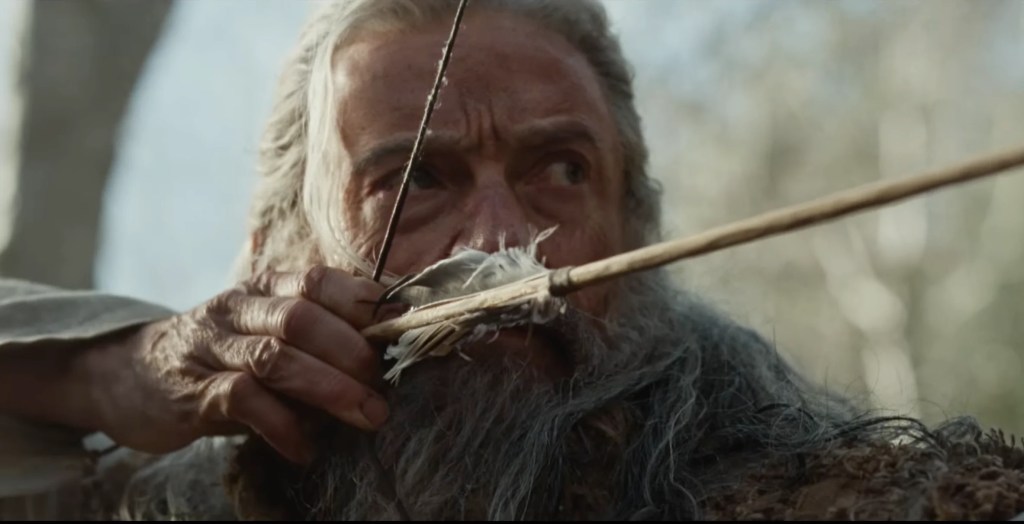
What if you finally made it to paradise, but the ghosts of your past still followed you there?
As loglines for adventure material goes, “The Death of Robin Hood” sounds unlike anything Hollywood has done with Robin of Loxley of late — Ridley Scott’s 2010 war drama “Robin Hood” notwithstanding — but there’s plenty of literary and cinematic precedent.
For one thing, Michael Sarnoski’s melancholic drama is based on some of the earliest surviving tales of the folk hero, including “A Gest of Robyn Hode” and “Robin Hood’s Death,” dating to around the 16th and 17th centuries (the latter inspired the 1976 Sean Connery starrer “Robin and Marian”). For another, the film plays like a modern legacy sequel to some unmade version of the famous stories, a feeling re-enforced by the presence of “Logan” star Hugh Jackman, as yet another grizzled hero reflecting on his legacy.
However, the point of Sarnoski’s latest genre deconstruction runs deeper than merely echoing or subverting modern IP. The resultant film rests heavy on the soul. It’s measured, thoughtful, and incredibly bleak in its vivid 13th century re-imagining of a man who, by all accounts, is the outlaw of everyone’s stories, but whose real past is far more vicious.
Sarnoski’s culinary revenge drama “Pig” and alien spinoff “A Quiet Place: Day One” had some magnificently moving dramatic detours. Here, he carves a period piece entirely out of those aforementioned, fleeting moments, transforming what was once breathing room into a suffocating fabric stretched across his story.
There’s no respite in “The Death of Robin Hood,” nowhere for Jackman’s grey and haggard Robin to escape (least of all, into his own thoughts) when the past comes biting at his heels. The story’s highland setting provides a thick, atmospheric fog, which reflects the way sorrow and remorse rest heavily atop every scene — especially its brutal prologue, in which a lonely, careworn Robin is forced to kill a young bandit who references his legends.
Things only get more savage from that point on, as Robin reunites with his once swashbuckling ward, “Little” John (Bill Skarsgård), now well into his adult years, and re-framed as a deeply, hilariously disturbed (albeit occasionally jovial) presence. John has a family now, but his and Robin’s merry band have made enemies over the years, leaving his loved ones in danger. Whether or not Robin and company ever stole from the rich and gave to the poor, they spilled blood along the way, culminating in what appears to be one final, doomed adventure to rescue John’s wife and daughter, from a tribe whose men have fallen victim to Robin’s arrows.
Perhaps the closest recent analogue to the ensuing action is Robert Eggers’s “The Northman,” if only for its visceral bloodshed steeped in historicity. On its own terms, the first act of “The Death of Robin Hood” plays out with such unrelenting visual and emotional anguish, awash in such destructive flames, that it may as well be folk horror.
However, this is merely a prelude to where the movie ends up, as the ongoing cycles of violence are interrupted—at least, temporarily—by Robin escaping to a lush priory on a nearby island with John’s young daughter Margaret (Faith Delaney) in his care, as he protects her from a world he helped create.
The plot is rigid in its unwillingness to depart from this spiritual introspection, but the film is all the better for it. The story leans into the unspoken elements hidden between the lines of centuries-old poems, from the overt Christian backdrop of these tales — friars and Church-appointed kings have been frequent fixtures of Robin’s folklore, but seldom has religion been such a central fixture — as well as the darker implications of a heroic figure whose defining characteristic is his weaponry.
Sarnoski’s purpose, in creating a Robin Hood with such a detestable morality, is not simply to strip folklore of childlike whimsy, but rather, to inspect the nature of legend, and the way following or worshiping human figures ultimately demands reckoning with their more complicated layer — which feels especially relevant in a world of cult-of-personality politics.
For most of its runtime, the movie deploys this tranquil setting as a kind of purgatory. Robin, while hiding his true identity, is forced into constant contact with characters like the kindly prioress Sister Brigid (Jodie Comer) and a helpful, unnamed leper (Murray Bartlett), people with their own mysterious, painful pasts, which they carry in every step, and every interaction.
Their welcoming presence despite their troubles, and the island’s general sense of community, forces the aged archer to consider whether redemption is possible, or something he even deserves, given the many people he’s harmed along the way — the women he’s widowed, the children he’s orphaned.
However, while these contemporary echoes are undoubtedly vital to Sarnoski’s reading, they’re a byproduct of a film that deploys each audio-visual element to create a mournful, poetic piece. Its movements are gradual, and glacial, but they bear an unrelenting ferocity, echoed through shots of ruins far older than the movie’s setting, as though Sarnoski were reaching even further into the past, in search of some unseen, unknowable place from which folklore itself might have sprung.
Cinematographer Pat Scola frays the edges of the frame (especially in close ups) as if to present Jackman’s folk villain as the subject of a portrait painted in rough, erratic strokes — a lensing not dissimilar to a contemporary classic that also investigates a mythologized figure, “The Assassination of Jesse James by the Coward Robert Ford.”
However, the movie’s greatest fixture is undoubtedly Jackman, whose gruff demeanor disguises a man broken by remorse, fighting himself at every turn. In the most intense dramatic scenes, his wrinkled face becomes a landscape of raw emotion and pulsing veins, as though the story’s sands were shifting in real time. And, for a film this intentional in its unspooling, it’s worth noting that Sarnoski and Scola make each frame a treat for the eyes, and for the soul, through compositions awash in light and shadow, which evoke a certain baroqueness — not of space and physical structures, but of the human form, as an architectural centerpiece.
The resultant work follows its core legend to its inevitable, sorrowful conclusions, far beyond the traditional confines of songs and stanzas, and into the human depths that often conjure such stories in the first place. The ties that bind societies and cultures together are often strengthened by belief, as a nebulous, external force fueled by myths and stories. With “The Death of Robin Hood,” Sarnoski cuts loose the twine holding them in place, ushering forth a flood of inhumanity — all while centering the question of whether our worst selves could possibly be deserving of grace. In a tale of such unforgiving brutality, there is perhaps no query more terrifyingly human.
Image credit: “The Death of Robin Hood”
This guest post is written by the best in the business, world class film critic Siddhant Adlakha.


 Video Game Town